
In an era where attention is the most valuable currency, understanding how to effectively partner with creators is no longer optional, it is essential. This guide serves as your strategic compass for 2026, offering a deep dive into the mechanics, metrics, and compliance standards that define successful influencer marketing in Australia today.
Executive Summary
Imagine standing in the middle of Martin Place in Sydney and shouting your brand’s message through a megaphone, only to realize everyone is wearing noise-cancelling headphones. This is the reality of digital advertising in 2026.
As we navigate the new year, Australian businesses face a perfect storm: the rising costs of paid media acquisition (CAC) and a deepening “Trust Deficit” between consumers and corporate entities. The era of “spray and pray” advertising, casting a wide net with generic messaging, is officially obsolete.
Influencer marketing has graduated from an experimental, peripheral tactic into a fundamental pillar of modern brand strategy. It is no longer about paying someone to hold a product; it is about leveraging the credibility of trusted voices to bypass consumer skepticism.
This comprehensive guide, drawing on proprietary market data and Australia Experiences’ proven track record with over 40 brands, provides a strategic blueprint for high-ROI influencer integration. Within these pages, we move beyond vanity metrics to dissect the psychology of influence, strategic tiering, complex contract negotiations, paid amplification, and the rigorous legal frameworks required to succeed in the Australian market. 🇦🇺
Part 1: The Paradigm Shift
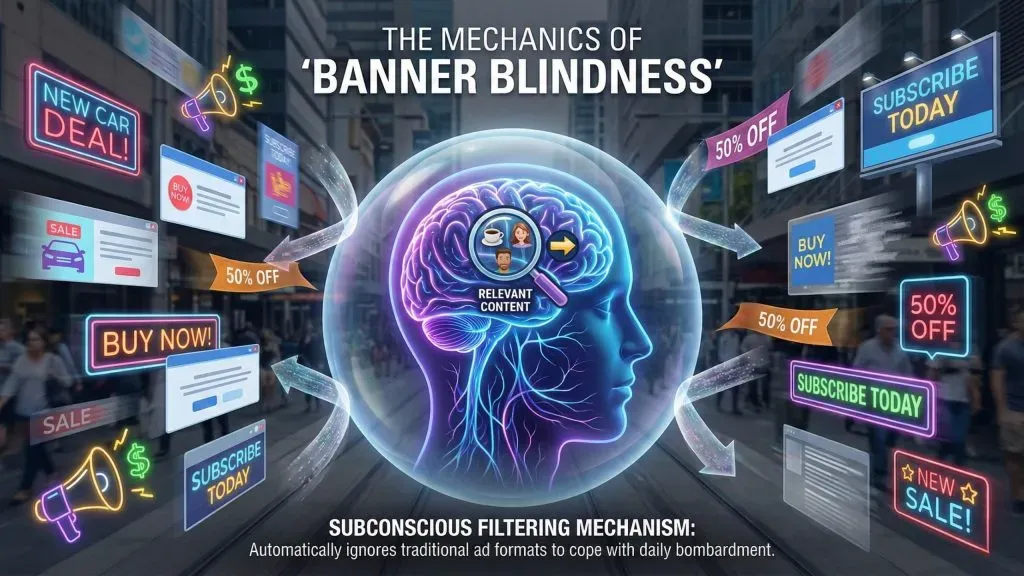
The human brain has adapted by developing “Banner Blindness”
From “Interruption” to “Connection”
To understand the necessity of influencer marketing in 2026, we must first confront the harsh reality of the current media landscape. Traditional digital advertising, display banners, pre-roll ads, and generic sponsored posts, is suffering from a crisis of effectiveness driven by fundamental changes in consumer psychology.
The Mechanics of “Banner Blindness”
The average Australian consumer is now bombarded with commercial messages every single day. To survive this onslaught, the human brain has adapted by developing “Banner Blindness”, a subconscious filtering mechanism that automatically ignores anything resembling a traditional advertisement.
This explains why click-through rates (CTR) for standard display ads in Australia have plummeted to below 0.1% in many sectors. We are shouting louder, but fewer people are listening. The “Interruption Marketing” model, where brands force their way into a consumer’s day, is yielding diminishing returns.
The Trust Deficit and Parasocial Relationships
Reports from Nielsen’s Trust in Advertising Study consistently highlight a widening gap in trust. Consumers view corporate messaging with inherent skepticism. When a brand claims, “We are the best,” it is perceived as marketing. When a friend says, “This is the best,” it is accepted as truth.
This is where the Creator Economy thrives. It operates on the psychological principle of Parasocial Relationships, one-sided relationships where a viewer feels a genuine, intimate connection with a content creator. When a creator shares a review, it is perceived not as a sales pitch, but as a peer recommendation. Statistics indicate that 92% of consumers trust earned media (reviews and word-of-mouth) more than any other form of advertising.
The Search Revolution: TikTok is the New Google
Perhaps the most critical shift for lifestyle, travel, and hospitality businesses is the fundamental change in search behavior. For Australians under 40, platforms like Instagram and TikTok have effectively replaced Google Search for discovery.
Google’s own executives have admitted this shift. As noted in industry reports, nearly 40% of young users prefer TikTok or Instagram for search over Google Maps or Search.
The customer journey has evolved drastically:
- The Old Path: Google “Best seafood restaurant Gold Coast” → Read text-heavy blog → Visit website.
- The New Path: Search “Gold Coast Eats” on TikTok → Watch 15-second sensory-rich video → Click link in bio → Book immediately.
If your brand does not exist in these short-form video ecosystems, you are effectively invisible during the critical “Discovery Phase” of the customer journey.
0.1%
Avg. Display Ad CTR
92%
Trust Earned Media
40%
Search via TikTok/IG
Part 2: The Strategy Framework
Integrating Influencers into the Full Marketing Funnel
At Australia Experiences, we advise clients to stop viewing influencer marketing as a standalone silo. Instead, it must be integrated into the broader marketing funnel, with specific tiers of talent deployed to achieve distinct strategic objectives.
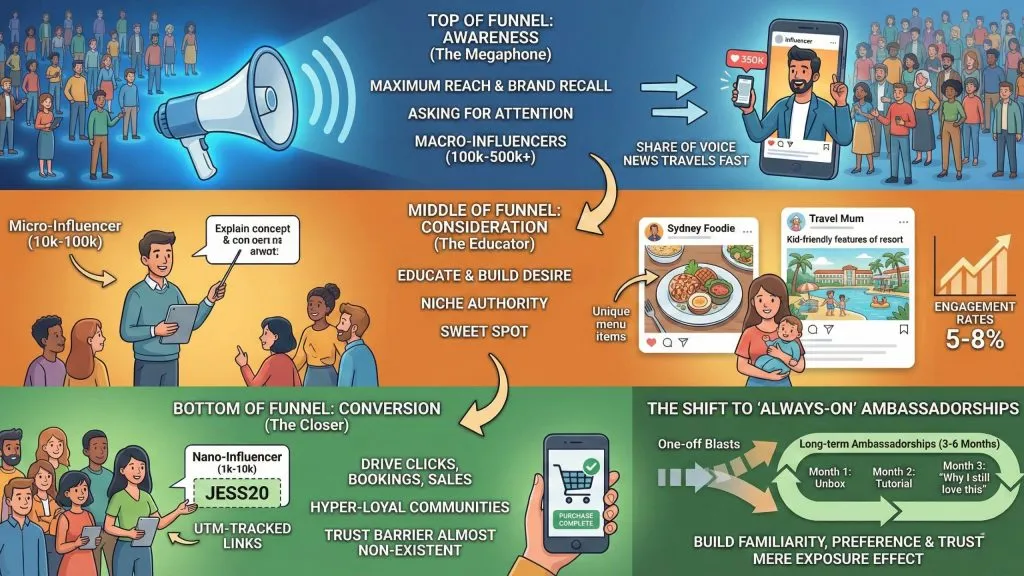
Integrating Influencers into the Full Marketing Funnel
Top of Funnel: Awareness (The Megaphone)
At this stage, the objective is maximum reach and brand recall. We are not yet asking for a sale; we are asking for attention.
Here, Macro-Influencers (100k - 500k+ followers) play a pivotal role. They act as the “Megaphone” for your brand. Using these creators is ideal for launching a new product line or announcing a major event where you need the news to travel fast. While their engagement rates are typically lower due to the breadth of their audience, their ability to place a brand in front of hundreds of thousands of Australians overnight is unmatched. The strategy here is about “Share of Voice”, ensuring your brand is seen, even if deep action doesn’t happen immediately.
Middle of Funnel: Consideration (The Educator)
Once awareness is established, the goal shifts to educating the consumer and building desire. This is the domain of the Micro-Influencer (10k - 100k followers).
This tier is often considered the “sweet spot” for Australian businesses. These creators possess niche authority. A “Sydney Foodie” explaining specifically why your menu stands out, or a “Travel Mum” demonstrating how kid-friendly your resort facilities are, builds the depth required for consideration. Our internal data shows Micro-influencers in Australia consistently deliver engagement rates of 5-8%, far outperforming the industry average. They bridge the gap between “I’ve heard of this brand” and “I want to try this brand.”
Bottom of Funnel: Conversion (The Closer)
Finally, we need to drive clicks, bookings, and sales. This is where Nano-Influencers (1k - 10k followers) and Affiliates excel.
These creators often manage hyper-loyal, tight-knit communities. Their recommendation carries the weight of a best friend’s advice. The tactical play here involves equipping them with unique tracking mechanisms, such as discount codes (e.g., “JESS20”) or UTM-tracked links. While the volume of followers is lower, the conversion rate is exceptionally high because the trust barrier is almost non-existent.
The Shift to “Always-On” Ambassadorships
One of the most effective strategic pivots we advocate for in 2026 is moving from “One-off Blasts” to “Long-term Ambassadorships.”
Hiring an influencer for a single post often feels transactional to the audience. They see it, recognize it as an ad, and scroll past. Conversely, an Ambassador contract spanning 3 to 6 months allows the creator to tell a story over time. They might unbox the product in Month 1, use it in a tutorial in Month 2, and share a “why I still love this” update in Month 3. This frequency builds the “Mere Exposure Effect,” where familiarity breeds preference and trust, keeping your brand top-of-mind.
Part 3: Learning from the Giants
Case Studies in Excellence
Theory is valuable, but real-world application provides the proof. We look to both industry leaders and our own methodologies to visualize success.
External Benchmark: Tourism Australia & The “Phygital” Shift
Tourism Australia revolutionized destination marketing by pivoting away from polished, high-budget TV commercials toward a “Phygital” (Physical + Digital) strategy with their “Come and Say G’day” and subsequent campaigns. They invited international creators to experience Australia in its raw, unfiltered state.
The lesson here is profound: polished perfection often feels fake to the modern consumer. Raw, handheld content feels authentic and attainable. Retail giants like Mecca and The Oodie have similarly built empires not by paying for Super Bowl ads, but by seeding products to thousands of micro-creators. They understood that in 2026, the quantity of authentic voices often outweighs the quality of studio production.
Case Study: The Viral Food Festival (VFF)
At Australia Experiences, we apply these enterprise-level strategies to local businesses. Our comprehensive work with the Viral Food Festival (VFF) across three seasons (Central Coast, Gold Coast, Canberra) serves as a definitive case study in O2O (Online-to-Offline) conversion.
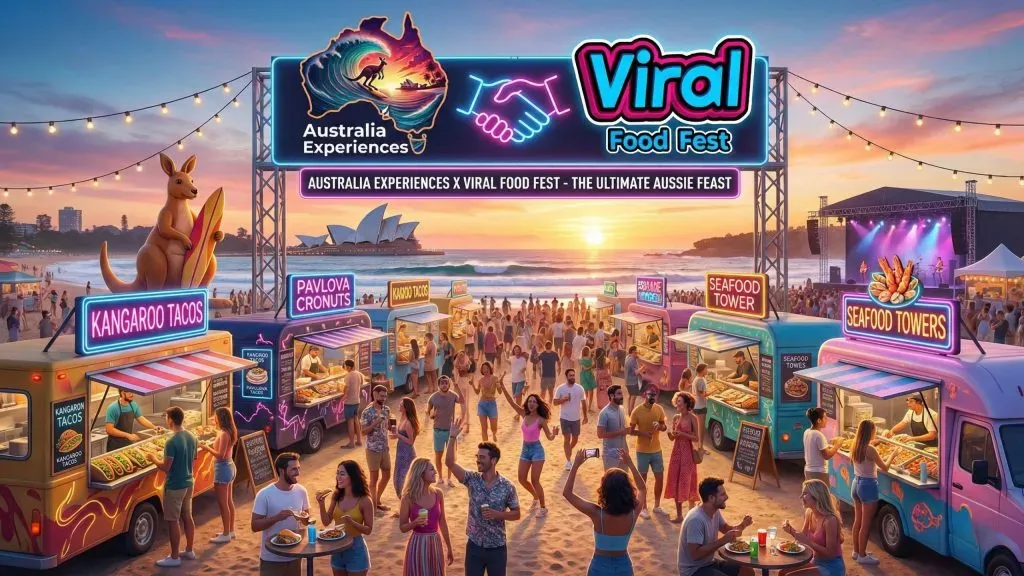
Internal Case Study: The Viral Food Festival (VFF)
The Challenge
The objective was ambitious: to move beyond simple digital “buzz” and drive physical ticket sales and foot traffic for a multi-city event series. We needed to convince people to get off their phones and attend a physical event.
The Execution
We eschewed the “scattergun” approach of hiring random influencers. Instead, we curated a specific “squad” of local lifestyle creators native to each region. We briefed them not just to show the food, but to capture the atmosphere, the sizzle of the grills, the sound of the live music, the energy of the crowd. The goal was to trigger a visceral “Fear Of Missing Out” (FOMO).
The Data & Impact
The results validated the strategy. The campaign generated an “Engagement Storm,” reaching over 150,000 unique users. More importantly, the content achieved an engagement rate 3x higher than the industry average, proving deep resonance.
Crucially, this digital hype translated into revenue. The festival welcomed over 45,000 visitors, exceeding all initial targets. This case study stands as proof that when you align local authority (Micro-influencers) with a compelling offline experience, the ROI is tangible and significant.
Part 4: The 2026 Pricing Guide (Benchmarks)
“How Much Should I Budget?”
Pricing in the influencer market is often opaque. While rates vary based on niche, engagement quality, and production value, the following are estimated industry benchmarks for the Australian market in 2026. Note: These figures generally cover the Content Creation + Posting Fee for one standard Reel/TikTok.
Nano-Influencers (1k - 10k Followers)
- Rate: Gifted Product (Barter) up to $350 AUD.
- Strategic Use: These are ideal for seeding campaigns, generating mass reviews, and building localized awareness. While enthusiasm is high, they may require more guidance with the creative brief.
Micro-Influencers (10k - 50k Followers)
- Rate: $350 - $1,500 AUD per video.
- Strategic Use: This is where you pay for credibility. These creators are perfect for targeted niche marketing (e.g., Vegan, Tech, Travel). You can expect professional content, reliable delivery, and a highly engaged comments section.
Mid-Tier Influencers (50k - 100k Followers)
- Rate: $1,500 - $4,000 AUD per video.
- Strategic Use: Mid-tier creators bridge the gap between awareness and conversion, often offering higher production value and a more polished aesthetic.
Macro-Influencers (100k - 500k Followers)
- Rate: $4,000 - $12,000+ AUD per video.
- Strategic Use: National Brand Awareness and Launch Campaigns.
Negotiation Variables: The Hidden Costs It is vital to budget for more than just the posting fee.
- Usage Rights: If you intend to use the influencer’s video in a TV ad, on your website, or as a dark post (Facebook Ad), expect to pay a 30-50% loading fee.
- Exclusivity: Demanding that an influencer not work with any competitors for 3 months restricts their income. Expect to pay a 50-100% loading fee for this privilege.
- Rush Fees: Demanding deliverables in under 48 hours will typically incur a premium.
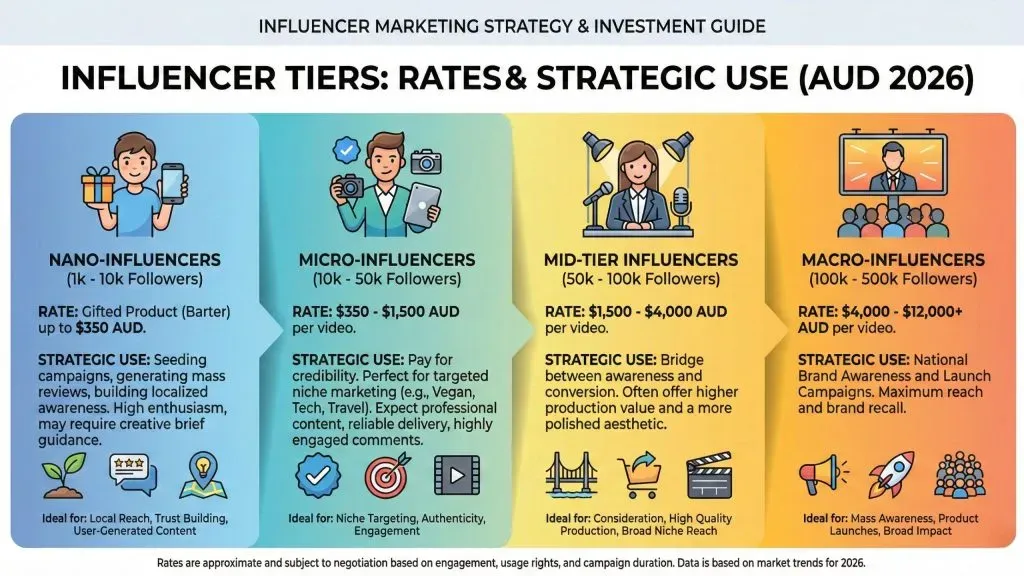
The 2026 Pricing Guide (Benchmarks)
Part 5: The Execution Mechanics
Operational Excellence: Where Most Businesses Fail
A brilliant strategy is useless without rigorous execution. Many businesses fail because they treat influencers like employees rather than creative partners. The following framework outlines the operational standard at Australia Experiences.
1. Vetting: The Art of Identifying Fraud
Before a single dollar is spent, the talent must be audited. Influencer fraud has become sophisticated. We look for two primary red flags:
- The Location Check: Does a “Sydney Influencer” actually have followers in Sydney? If 40% of their audience is located in Brazil, Turkey, or Russia, they have likely purchased fake followers.
- The “Pod” Check: We analyze the comments section. Are the comments generic emojis () from other influencers? This indicates participation in an “Engagement Pod”, a group of creators who artificially like each other’s posts to trick the algorithm. This brings zero commercial value to your brand.
2. The Art of the Collaborative Brief
A vague brief leads to vague results, while a restrictive brief leads to robotic content. We adhere to the “Freedom within a Framework” rule.
- The Framework: We provide the non-negotiables. This includes key messages (e.g., “Must mention the new summer menu”), must-have visuals (e.g., “Close up of product texture”), and the Call to Action (e.g., “Click link in bio”).
- The Freedom: We let the creator decide how to film and edit the content. They understand the nuances of their audience better than any brand manager. Trusting their creative intuition usually yields higher engagement.
3. Contracts & Usage Rights: The Legal Shield
This is the most dangerously overlooked aspect of influencer marketing. A common myth is: “I paid for the post, so I own the video.” This is false. Under Australian Copyright Law, the creator retains ownership of the content unless it is explicitly assigned to you in writing.
To protect your investment, “Usage Rights” must be negotiated upfront. The contract should specify exactly where the content can be used (e.g., social media only, or digital ads), for how long (e.g., 6 months), and in what territories (e.g., Australia only vs Global).
4. Advanced Tactic: Whitelisting & Dark Posting
In 2026, organic reach is declining. The solution is “Whitelisting” (or Partnership Ads on Meta/TikTok). Instead of sharing the influencer’s post to your brand’s page (which limits reach to your existing followers), you gain access to run a paid ad through the influencer’s handle.
Why does this win? Because consumers scroll past brand logos but stop for human faces. Whitelisted ads appear native to the feed, leveraging the influencer’s credibility while utilizing the precise targeting capabilities of the Facebook/TikTok ad manager. Data shows these ads typically achieve 20-30% higher Click-Through Rates (CTR) than standard brand ads.
Part 6: The Financials
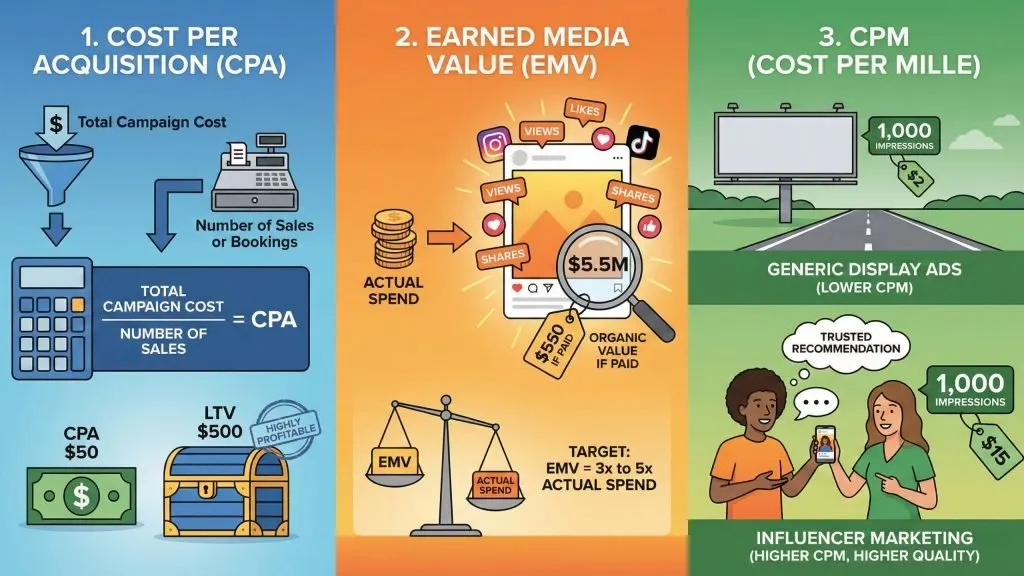
If you are reporting to a board, CFO, or business owner, “likes” are insufficient.
Measuring What Matters
If you are reporting to a board, CFO, or business owner, “likes” are insufficient. You must speak the language of finance.
1. Cost Per Acquisition (CPA)
This is the ultimate metric. Calculated as Total Campaign Cost / Number of Sales or Bookings. This tells you exactly how much it costs to “buy” a customer through this channel. If your CPA is $50 and the customer Lifetime Value (LTV) is $500, the campaign is highly profitable.
2. Earned Media Value (EMV)
EMV helps justify brand awareness spend. It asks: If you had to pay Instagram/TikTok directly to get the same number of organic views, likes, and shares, how much would it cost? A healthy campaign should deliver an EMV of 3x to 5x the actual spend.
3. CPM (Cost Per Mille)
While influencer marketing often has a higher CPM (Cost per 1,000 impressions) than generic programmatic display ads, the quality and attention span of those impressions are significantly higher. It is the difference between a billboard on a highway and a recommendation from a friend.
4. Sentiment Analysis
Beyond the spreadsheet, we must “read the room.” Are people tagging friends saying “We need to go here next week”? This qualitative data is crucial for forecasting future demand and brand perception.
Part 7: Compliance and Legal Safety
Navigating the Australian Regulatory Landscape
Australia possesses one of the strictest regulatory environments for influencer marketing globally. The Australian Influencer Marketing Council (AiMCO), the ACCC, and specialized bodies enforce clear rules. Ignorance is not a valid defense in court.
Disclosure is Non-Negotiable
Every piece of content where value has been exchanged, whether money, free product, or a hotel stay, must be clearly labeled.
- Acceptable: Tags must be unambiguous, such as #Ad, #Sponsored, or #PaidPartnership.
- Unacceptable: Vague terms like #Collab, #Gifted, or hiding tags in the “more” section are prohibited. The disclosure must be visible before the consumer engages with the content.
Industry-Specific Regulations
- Therapeutic Goods (TGA): If your business involves health, vitamins, or skincare, strict TGA social media rules apply. Influencers cannot offer personal testimonials for therapeutic goods (“This cured my acne”) in the same way they can for a dress. They can only state what the product is officially approved to do. Breaches can result in massive fines.
- Alcohol Advertising (ABAC): For hospitality brands, the ABAC Responsible Alcohol Marketing Code is critical. Influencers must have an audience that is at least 75% adult (18+), and content cannot imply that alcohol contributes to social or sexual success.
- Financial Services (ASIC): “Fin-fluencers” are under the microscope. Unless licensed, influencers cannot give specific financial advice under ASIC Info Sheet 269.
At Australia Experiences, we act as a compliance shield. We ensure every contract and every post serves the brand while strictly adhering to Australian consumer law, protecting your reputation from potential fines.
Part 8: Future-Proofing (2026 and Beyond)
As we look ahead, two major trends are reshaping the landscape.
1. The Rise of AI Influencers Virtual influencers are gaining traction. While they lack the “human” touch, they offer brands total control over messaging and zero risk of scandal. We are seeing early adoption in the fashion and tech sectors in Australia, allowing for 24/7 content creation without human fatigue.
2. Live Shopping Maturity Already a trillion-dollar industry in Asia, Live Shopping is finally maturing in Australia. Brands are hiring influencers not just to post static videos, but to host live streams where viewers can purchase products in real-time. This collapses the funnel from “Awareness” to “Conversion” into a single, interactive moment.
!
Conclusion: The Path Forward
Influencer marketing in 2026 is complex, nuanced, and highly technical. It requires a blend of creative intuition and data-driven rigor. It is no longer about finding someone “famous” to hold your product; it is about finding a partner who can translate your brand values into a language their community understands.
For Australian businesses, the choice is no longer if you should use influencers, but how. Will you continue to rely on fading traditional ads? Or will you leverage the authentic voices of creators to build genuine connections?
Whether you are a boutique agency looking for a steady stream of leads, or a large-scale event organizer aiming for 45,000 visitors like our partners at the Viral Food Festival, the formula remains consistent: Authenticity + Strategic Tiering + Rigorous Execution.
You do not have to navigate this landscape alone. With a proven track record of managing high-performance campaigns for over 40 clients, Australia Experiences is uniquely positioned to help you turn content into revenue.
Let’s define your 2026 strategy today with Australia Experiences.
- 2026 Australia Experiences. All Rights Reserved.*.