
A definitive roadmap for international brands to navigate cultural nuances, build authentic trust, and drive revenue in the Australian market.
Executive Summary
In a Rush? Here is the Strategic Blueprint: This guide challenges the “copy-paste” global strategies that fail in the Australian market. We dissect the critical cultural nuances-such as “Tall Poppy Syndrome” and the “No Fluff” radar-that dictate B2B buying behavior in 2026. You will learn why hyper-localisation (down to the spelling and accent) is non-negotiable, how to leverage the critical End of Financial Year (EOFY) sales window, and why partnering with local creators via platforms like Australia Experiences is the most effective way to build trust at scale.
Introduction: The “Global Playbook” Trap and the Trust Deficit
By the year 2026, LinkedIn has undeniably cemented its position as the central nervous system of the Australian business landscape. With user numbers projecting past 17 million, effectively covering the entire white-collar workforce and a significant portion of the skilled trades sector, the platform has evolved far beyond a digital rolodex. For B2B organizations targeting Australia, LinkedIn is no longer just a channel for brand awareness; it is the primary battleground where reputations are forged, partnerships are initiated, and revenue is generated.
However, a persistent and costly paradox continues to plague international entrants. Whether they are SaaS giants from Silicon Valley, manufacturing powerhouses from Southeast Asia, or financial service providers from London, many arrive on Australian shores with a confident “global strategy” that has worked flawlessly in other markets. They deploy the same high-pressure sales scripts, the same aggressive “number one” branding, and the same automated outreach sequences that brought them success in New York or Shanghai.
The result is often deafening silence.
Response rates plummet to near zero. Cost Per Lead (CPL) metrics skyrocket well above global averages. Marketing teams are left scratching their heads, blaming the algorithm or the budget, when the real culprit is far more subtle and entrenched. The issue is not the platform; it is a fundamental misunderstanding of Cultural Nuance and Trust.
As we move deeper into 2026, the “Trust Deficit” in B2B marketing has reached an all-time high. Australian decision-makers, bombarded by AI-generated noise and generic sales pitches, have developed a sophisticated, almost cynical filter against anything that feels artificial, industrial, or overly promotional. They do not buy from “vendors” who treat them as numbers in a sequence; they buy from “partners” who understand their specific context.
This article serves as your comprehensive, strategic roadmap to navigating this unique B2B landscape. We will move beyond the superficial tips of profile optimization to explore the advanced psychology of the Australian buyer, the art of hyper-localised storytelling, and the critical importance of timing your campaigns around the Australian fiscal calendar.
Part 1: Decoding the Aussie B2B Mindset (The Psychology of Selling)
To succeed in Australia, you must first unlearn some of the aggressive tactics that dominate the US market and the hierarchical formalities often found in Asian business cultures. The Australian business psyche is distinct, shaped by a history of egalitarianism and a specific set of social values that dictate how business is done.
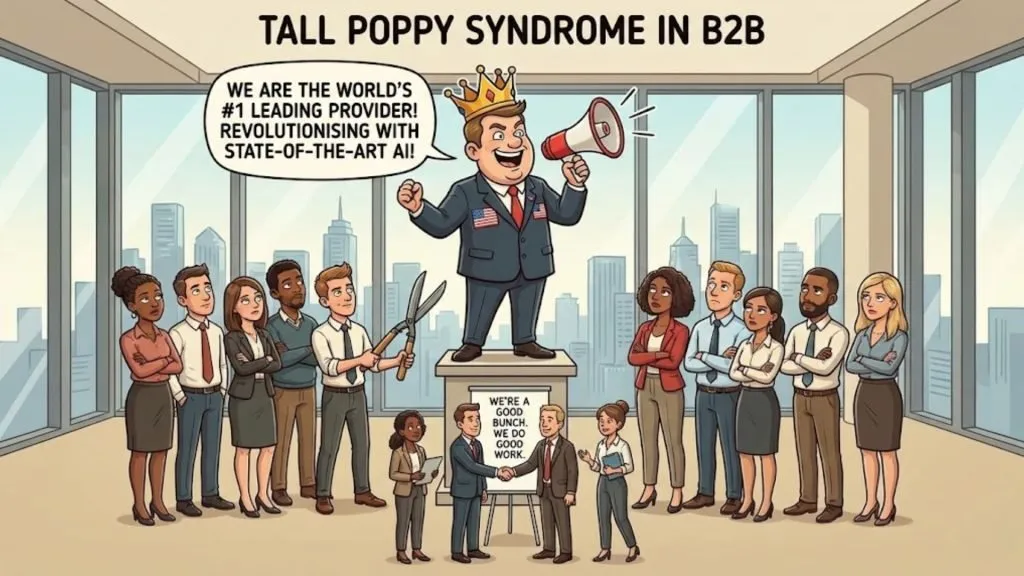
The most critical cultural concept for any marketer targeting Australia is “Tall Poppy Syndrome.”
1.1. Tall Poppy Syndrome: The Silent Deal Killer
Perhaps the most critical cultural concept for any marketer targeting Australia is “Tall Poppy Syndrome.” This sociological phenomenon refers to the tendency of Australian society to “cut down” those who are perceived as being too self-important, boastful, or striving to appear superior to their peers. In a B2B context, this has profound implications for your messaging strategy.
Consider the typical American sales pitch: “We are the World’s #1 Leading Provider of X, revolutionising the industry with our state-of-the-art AI.” In the US, this signals ambition and success. In Australia, it signals arrogance. The immediate Australian reaction is not admiration, but skepticism. The internal monologue of the Australian buyer is often, “If you have to tell me you’re the leader, you probably aren’t. And if you are that good, why are you trying so hard to impress me?”
The winning strategy in this environment is Confident Humility. This is a delicate balance where you let your results speak for themselves rather than shouting about them. Instead of claiming to be the “best” or “unrivalled,” successful marketers focus on the tangible impact they have delivered for others. A phrase like “Proud to support over 500 Australian businesses in simplifying their complex payroll needs” resonates far more deeply because it centers the client as the hero, not the vendor. It suggests partnership and service, whereas superlatives suggest dominance and ego.
1.2. The “No Fluff” Radar & The BS Detector
In 2026, the Australian tolerance for corporate jargon and “fluff” has hit rock bottom. Decades of straight-talking culture combined with the modern fatigue of information overload means that Australian buyers value directness above almost all else. If you attempt to obscure a lack of value with fancy words, you will be discovered and dismissed immediately.
Research from the Edelman Trust Barometer (Australia Edition) consistently highlights a “Crisis of Authority,” where Australians place significantly more trust in “technical experts” or “a person like yourself” than they do in CEOs or official brand messaging. This skepticism extends to your content marketing. If your LinkedIn post requires a reader to wade through three paragraphs of context-setting and buzzwords before reaching the point, you have already lost them.
The “No Fluff” policy demands that you respect the reader’s intelligence and their time. Your content should deliver value in the very first sentence. If you are selling a solution, state the problem you solve clearly and concisely without wrapping it in layers of corporate speak. For example, instead of saying “We leverage synergistic paradigms to optimise workflow output,” simply say “We help you get invoices paid faster.” The latter builds trust because it is honest; the former destroys it because it feels like a trick.
1.3. “Mateship” and Low Power Distance
Business partnerships in Australia are often built on a foundation of equality, a concept locally referred to as “Mateship.” In terms of Hofstede’s cultural dimensions, Australia scores very low on “Power Distance.” This means that hierarchy is respected but not revered.
The implication for your outreach strategy is significant. In many Asian or European markets, addressing a C-Level executive requires formal titles and deferential language. In Australia, however, it is culturally acceptable-and often preferred-to address C-Level executives by their first name in initial correspondence. Using titles like “Mr.,” “Mrs.,” or “Dr.” can actually create an awkward psychological barrier. It signals that you are an outsider who doesn’t understand the relaxed nature of local business, or worse, that you are placing yourself in a subservient position rather than that of a peer.
Your goal is not to be a vendor bowing to a master, but a reliable “Mate” in business-someone who is easy to work with, transparent about pricing and capabilities, and completely devoid of pretension. This informality should not be mistaken for unprofessionalism; rather, it is a sign of a sophisticated understanding that business is ultimately done between people, not functions.
Part 2: Building a “True Blue” Foundation (Advanced Localization)
Before you launch a single ad campaign or send an outreach message, your digital presence must pass the “Local Vibe Check.” If your profile screams “Offshore Vendor,” your acceptance rates will remain low regardless of how good your product is.
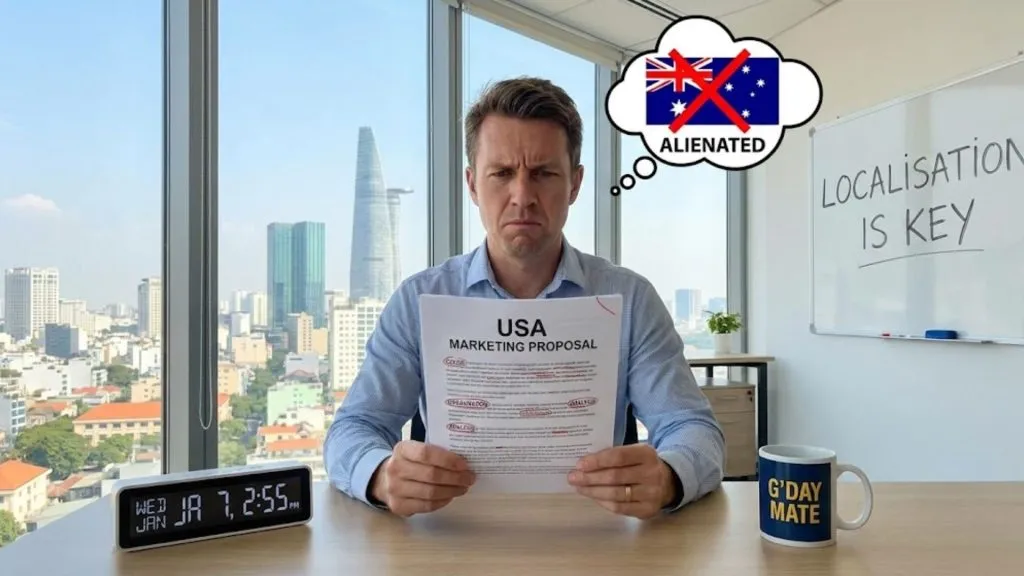
Australian English is a unique blend of British spelling and a distinct local vocabulary
2.1. Linguistic Localisation: More Than Just Spelling
Many companies assume that because Australians speak English, no translation is needed. This is a fatal error. Australian English is a unique blend of British spelling and a distinct local vocabulary. Using American spelling is one of the fastest ways to alienate a potential buyer.
When an Australian reads Organize, Color, or Center instead of Organise, Colour, and Centre, it acts as a subtle but powerful subconscious signal. It tells them that the message was mass-produced, likely in the US, and sent to thousands of people indiscriminately. It screams “generic.” On the other hand, adopting local spelling signals that you have taken the time to tailor your approach to their market. It shows respect.
But it goes beyond spelling. It is about tone. Australian business writing is generally less formal than British English but less hyperbolic than American English. It sits in a “Goldilocks” zone of professional yet conversational. For example, instead of signing off with a formal “Sincerely,” a simple “Cheers” or “Best regards” is often more appropriate and helps build that crucial rapport.
2.2. Location Signals and Social Proof
The algorithm on LinkedIn is designed to foster local connections. If you are purely offshore, you are fighting an uphill battle against the algorithm’s preference for geo-local relevance.
If you have any local presence whatsoever-a single representative, a shared office space, or a local partner-ensure this is explicitly listed on your Company Page and personal profiles. If you do not have a physical presence, you must verbally signal your commitment to the region. Mentioning your “APAC Support Team” or “Australian Service Hours” in your bio helps alleviate the common fear that working with an international vendor will mean delayed support due to time zone differences.
Furthermore, your social proof must be relevant. Listing a Fortune 500 US client might look impressive, but it can also feel distant. An Australian buyer wants to know if you can handle the specific regulatory and market conditions of their country. If you lack Australian case studies, bridge the gap by highlighting clients from the UK, New Zealand, or Canada-markets that share similar legal frameworks and business structures. This “Commonwealth Bridge” is far more effective than referencing clients from markets with vastly different operating environments like China or the US.
Part 3: Content Strategy 2026 - The Era of “Zero-Click” & Hyper-Authenticity
The era of posting a link to your corporate blog with the caption “Read more here” is definitively over. In 2026, LinkedIn’s algorithm heavily penalises posts that attempt to drive users off the platform. More importantly, user behavior has shifted. Australians are “scrollers”-they want to consume the full insight right there in the feed.
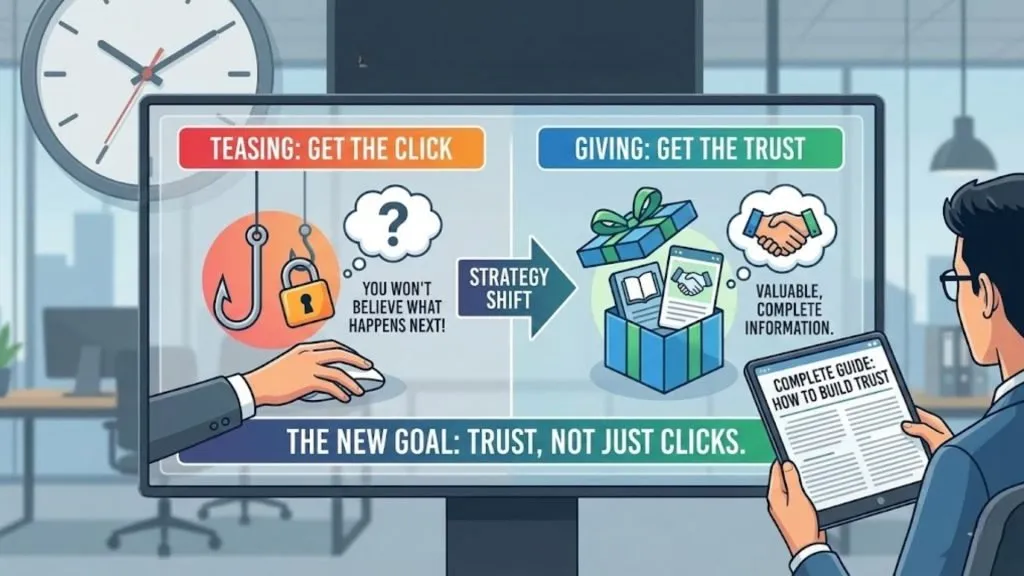
Your content strategy must shift from “Teasing” to “Giving.”
3.1. The “Zero-Click” Content Model
Your content strategy must shift from “Teasing” to “Giving.” The goal is no longer to get the click; the goal is to get the trust.
This means your posts should be self-contained units of value. If you have written a complex whitepaper, break it down into a carousel of 8-10 slides that summarizes the key findings. If you have an insightful analysis, write the full argument in the body of the post. The “Zero-Click” rule states that a reader should learn something valuable and actionable without ever leaving LinkedIn.
When you give value freely, you build authority. The psychology here is reciprocity. By providing high-quality insights upfront without asking for a “click” payment, you differentiate yourself from the thousands of other marketers trying to extract value. When the time comes that they need a solution, they will visit your profile because they already trust your expertise.
3.2. Solving the “Outsider” Problem: The Local Creator Strategy
This is perhaps the most advanced and impactful tactic for international companies in 2026. The biggest psychological barrier you face is the lack of “Local Context.” You cannot film a video talking about the challenges of the “Sydney market” when the street scene behind you is clearly New York, Singapore, or London. The visual dissonance destroys trust before you even finish your first sentence.
The Solution: Decentralised Storytelling.
Forward-thinking CMOs are moving budget away from high-gloss, centralized TV commercials towards User Generated Content (UGC) and partnerships with local niche creators.
Imagine a scenario where your brand is being discussed by a local industry expert, filmed against the backdrop of the Sydney Harbour Bridge or a bustling Melbourne laneway. The narrator speaks with a genuine Australian accent, uses local idioms, and references local landmarks. Immediately, the viewer’s “foreigner filter” is disarmed. They categorise your brand as being “here” and “present.”
Strategic Recommendation: Collaborate, Don’t Simulate.
Instead of trying to fake a local presence with stock footage or green screens, smart brands are partnering with platforms like Australia Experiences (Business Solutions). This platform solves the content gap by connecting international businesses with a vetted network of local storytellers and creators across Sydney, Melbourne, Brisbane, and Perth.
By briefing a local creator through this service, you can commission authentic video content-such as street interviews (“vox pops”), product reviews, or “day in the life” narratives-that are visually and aurally indistinguishable from a locally grown brand. This approach is not only cost-effective-often costing a fraction of flying a production crew to Australia-but it is also algorithmically superior. LinkedIn in 2026 favours vertical, authentic, human-centric video content over polished corporate ads. When a prospect sees your brand integrated naturally into the Australian environment, trust is established almost instantly.
3.3. Content Pillars that Resonate
To maintain a consistent presence, your content calendar should revolve around three key pillars:
The Educator (40%): This content breaks down complex Australian regulations or market trends. For example, explaining the implications of the latest Privacy Act updates or ESG reporting standards for Australian CFOs. This positions you as a helpful expert who is keeping them compliant and ahead of the curve.
The Contrarian (30%): Australians love a good debate-it’s the digital equivalent of the “Pub Test.” Challenge a popular industry belief. For instance, writing a post titled “Why everyone in Sydney is wrong about the return to office mandates” drives engagement because it invites opinion. However, ensure your contrarian take is backed by logic, not just provocation.
The Human (30%): This is where you show the people behind the logo. Share behind-the-scenes failures, lessons learned, and team moments. Crucially, use humor. Self-deprecating humor (“taking the piss out of oneself”) is a sign of extreme confidence in Australia and is highly endearing to local buyers. It shows you don’t take yourself too seriously, which aligns perfectly with the cultural value of “No Fluff.”
Part 4: The EOFY Phenomenon (Timing is Everything)
One specific nuance that catches almost every international marketer off guard is the Australian fiscal calendar. Unlike the US or Europe, where the financial year ends on December 31st, the Australian financial year runs from July 1st to June 30th.
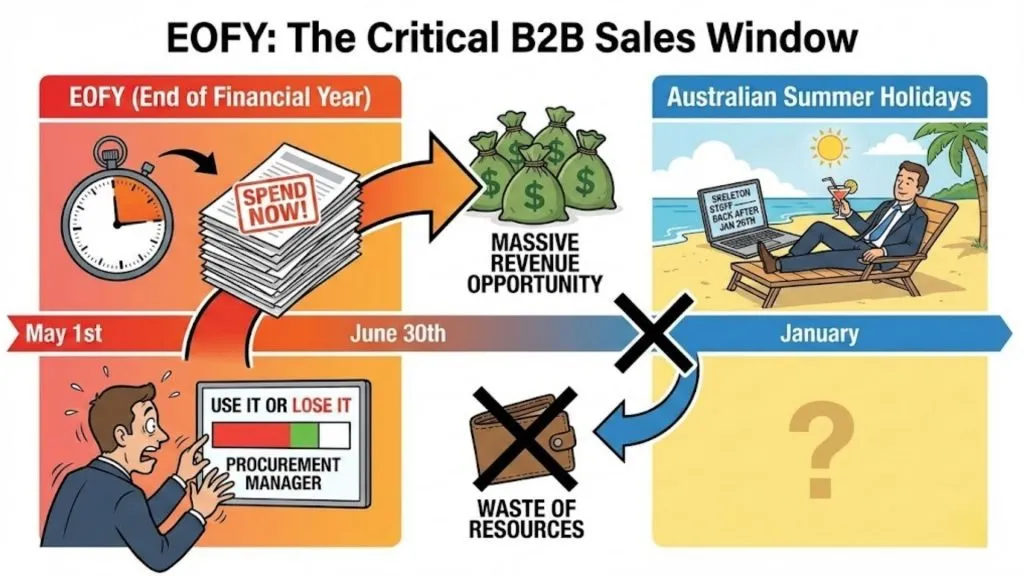
The period from May 1st to June 30th-known as EOFY (End of Financial Year)
4.1. The “June Madness”
The period from May 1st to June 30th-known as EOFY (End of Financial Year)-is the single most important window for B2B sales in Australia.
During these eight weeks, businesses are actively looking to spend their remaining budget. The mindset of a procurement manager shifts from “save money” to “use it or lose it.” Decisions that usually take months can happen in days during June because the budget will disappear if not allocated before midnight on June 30th. Furthermore, many purchases are tax-deductible in the current financial year, adding another layer of urgency.
If your marketing strategy is quiet in May and June, you are leaving massive amounts of revenue on the table. Conversely, launching a major new campaign in January is often a waste of resources. January is the peak of the Australian summer holidays. Most decision-makers are at the beach, and business operates on a skeleton staff until after Australia Day (January 26th).
Action Plan: Your calendar should be weighted heavily towards Q2 (April-June). Begin warming up your leads in April. In May and June, launch aggressive “EOFY Offers” or packages designed to fit into remaining budgets. Then, use January for brand awareness and “soft” content, acknowledging the holiday vibe rather than pushing for hard sales.
Part 5: Account-Based Marketing (ABM) & Outreach
Australia has a highly concentrated economy. In major sectors like Banking, Retail, Mining, and Telecommunications, the market is dominated by an oligopoly of 4-5 major players (e.g., the “Big Four” banks, the mining giants like BHP and Rio Tinto). This market structure makes mass marketing wasteful. You need a sniper approach, not a shotgun approach.
5.1. The “Surround Sound” Strategy
Your goal is to become a known entity within your “Dream 50” accounts before you ever ask for a meeting. This involves mapping the buying committee-which in 2026 averages 8-10 people-and engaging them with tiered content.
Do not pitch the C-Suite directly. Instead, engage with their thought leadership. Share their content with your own insightful commentary. For the Director level, send high-value, “Zero-Click” insights via InMail. For the end-users, target them with “How-to” ads to build ground-level advocacy. When you finally reach out, you are not a stranger; you are that brand that “everyone seems to be talking about.”
5.2. The Outreach Framework: Warm is the New Cold
Cold outreach is effectively dead. “Warm” outreach is the only way forward. The golden rule of Australian networking is: Never pitch in the connection request.
A connection request that says, “Hi Dave, we help companies save 30%…” is deleted immediately. It is viewed as spam. Instead, use a contextual approach. Reference a specific piece of content they produced or an event they attended. “Hi Dave, I listened to your interview on the (Podcast Name) last week. Really agreed with your point about (Specific Point). Would love to connect to keep up with your work. Cheers.”
Once connected, resist the urge to pounce. Use a “Give first” sequence. Wait a week, then send a value-drop-a benchmark report or a whitepaper-without asking for anything in return. Attach the PDF directly; do not force them to a landing page to fill out a form. Only after you have provided value and received engagement should you move to a “soft ask,” such as inviting them to a roundtable or asking for their perspective on a specific issue. This patience builds the social capital necessary to ask for a meeting later.
Part 6: Paid Advertising - Precision over Volume
Australia consistently ranks as one of the most expensive advertising markets on LinkedIn, with CPM (Cost Per Mille) often rivaling or exceeding the US. You cannot afford to “Spray and Pray.”
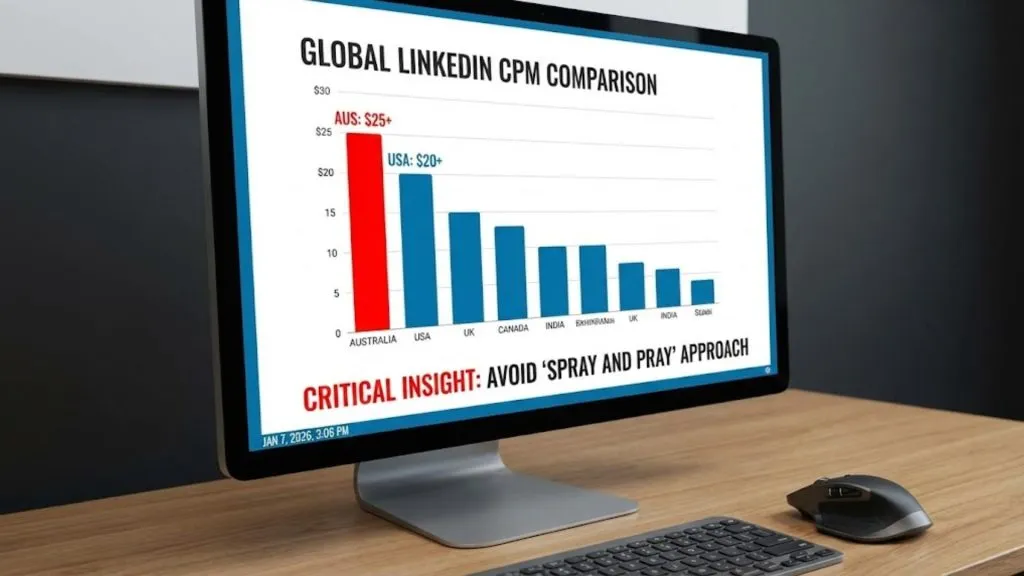
Australia consistently ranks as one of the most expensive advertising markets on LinkedIn
6.1. Thought Leader Ads
The breakout format of 2025-2026 is the Thought Leader Ad. This format allows you to promote a personal post from an employee’s handle (like your CEO or Country Manager) rather than from the company logo.
These ads perform exceptionally well because they look like organic content. They bypass the mental “ad blocker” that users have developed. By boosting a genuine opinion piece or a helpful insight from a human face, you build trust much faster than with a glossy corporate banner. The strategy here is to have your local country manager write an opinion piece on a local issue, and then put ad spend behind it targeting your “Dream 50” accounts.
6.2. The Retargeting Funnel
Your ad spend should be structured as a funnel. At the top, use short, authentic video content (UGC style via Australia Experiences creators) or “Zero-Click” Document Ads to generate awareness and video views. This creates a “warm audience.”
Retarget those who watched at least 50% of the video with a Case Study Carousel featuring a client in a similar industry. This moves them from awareness to consideration. Finally, serve direct offers (like a Demo Request or a Free Audit) only to those who have engaged with the previous steps and visited your pricing page. This ensures your expensive conversion budget is only spent on high-intent leads, keeping your Cost Per Acquisition (CPA) manageable in a high-cost market.
Conclusion: Authenticity is the Ultimate Weapon
The Australian B2B market in 2026 presents a unique paradox: it is culturally laid-back yet commercially demanding; it is friendly and open, yet deeply skeptical of sales tactics.
To succeed here, you must shed the corporate armor that protects you in other markets. You must be willing to be human, to be direct, and to be a “mate.” It requires a deep commitment to localisation-from the spelling in your bio to the accent in your videos. It requires a generosity of spirit-giving value freely through zero-click content. And it requires patience-respecting the relationship-first nature of business.
Don’t try to be a distant multinational corporation shouting from an ivory tower. Be a trusted partner who understands the local terrain. And if you need to bridge the physical gap, leverage the power of the local creative community through solutions like Australia Experiences to bring that authentic “Aussie breath” into your marketing. The market is waiting, and the opportunities are vast for those who take the time to understand the rules. Good on ya!