
In a digital landscape saturated by AI perfection, the Australian market is rebelling. This report explores why 2026 marks the end of the ‘Influencer Era’ and the dawn of a new economy built on gritty reality, trust, and verification.
Executive Abstract
In the mid-2020s, the marketing world braced for the AI revolution, expecting a future of hyper-efficiency and automated perfection. By 2026, the reality in Australia is starkly different. We are witnessing a “Human Recoil”- a massive cultural and economic swing away from synthetic perfection toward “verified reality.”
This report analyzes the collapse of the traditional “Attention Economy” and the rise of the “Trust Economy,” providing a roadmap for Australian businesses to navigate a landscape where flaws are assets, and verification is the ultimate currency.
Part I: The Great “AI-Fatigue” and the Australian Bullshit Detector
1.1 The Landscape of 2026: Drowning in “Slop”
It is January 2026. Open your phone. What do you see?
You see a video of a stunning woman recommending a skincare routine. Her skin has the texture of polished marble, devoid of pores or texture. Her lighting is cinematic, casting no unflattering shadows. Her voice is melodious, perfectly paced, devoid of hesitation, and eerily consistent in tone.
And you scroll past it in 0.4 seconds.
Why? Because your brain, evolved over hundreds of thousands of years to detect threats, social cues, and biological truths, has subconsciously flagged it: Synthetic.
In 2026, perfection is no longer an aspiration; it is a warning sign. With the commoditization of Generative AI, creating “perfect” content has become free, instant, and infinite. The internet is flooded with what cultural critics now call “AI Slop”- mass-produced, hallucinated, and soulless content designed to game algorithms. Consequently, the economic value of perfection has plummeted to zero. When everyone can be perfect, no one is interesting.
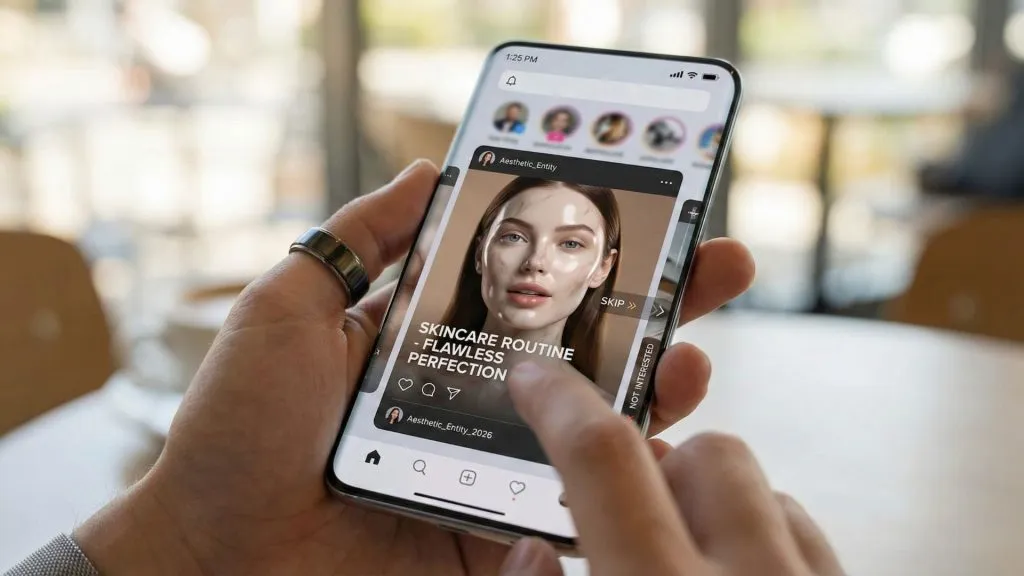
In 2026, perfection is no longer an aspiration
1.2 The Cultural Context: Australia’s “Tall Poppy” Defense
We have entered the Post-Truth Marketing Era, and nowhere is this felt more acutely than in Australia.
Culturally, Australians have always possessed a highly sensitive “BS detector.” This is the nation that coined the “Tall Poppy Syndrome”- the cultural tendency to cut down those who appear too elevated, boastful, or self-important. Historically, this was a social leveler. In 2026, it has become a survival mechanism against the “AI-ification” of human experience.
The Australian consumer views “slickness” with inherent suspicion. A polished corporate video is not seen as professional; it is seen as a disguise. This skepticism has been exacerbated by the “Deepfake Scams of 2024-2025,” where thousands of Australians lost money to AI-generated celebrity endorsements. The collective trauma of these digital deceptions has hardened the national psyche.
1.3 The Data of Distrust
The numbers paint a brutal picture for traditional advertisers. According to the 2025 Edelman Trust Barometer (Australia Edition), trust in traditional advertising and corporate messaging has hit a historic low of 14%.
However, the data reveals a fascinating inverse correlation: as trust in “Institutions” and “Brands” declines, trust in “Peers” and “Strangers” skyrockets.
- 78% of Australian consumers say they will actively block or report content that they suspect is AI-generated without a clear disclosure label.
- 62% claim they are more likely to buy a product if the review video is “low quality” (e.g., poor lighting, background noise, shaky camera) compared to “studio quality.”
- 89% of Gen Z and Alpha Australians admit to appending the word “Reddit” or “scam” to their Google searches to bypass SEO-optimized articles and find real human opinions.
(Source: Nielsen Annual Marketing Report, Pacific Region, late 2025; Australian Bureau of Statistics - Digital Trust Survey 2025)
The implications for business are seismic. The marketing funnel hasn’t just changed; it has inverted. We are no longer fighting for “Attention” (which AI can grab easily with flashy visuals); we are fighting for “Validation.”
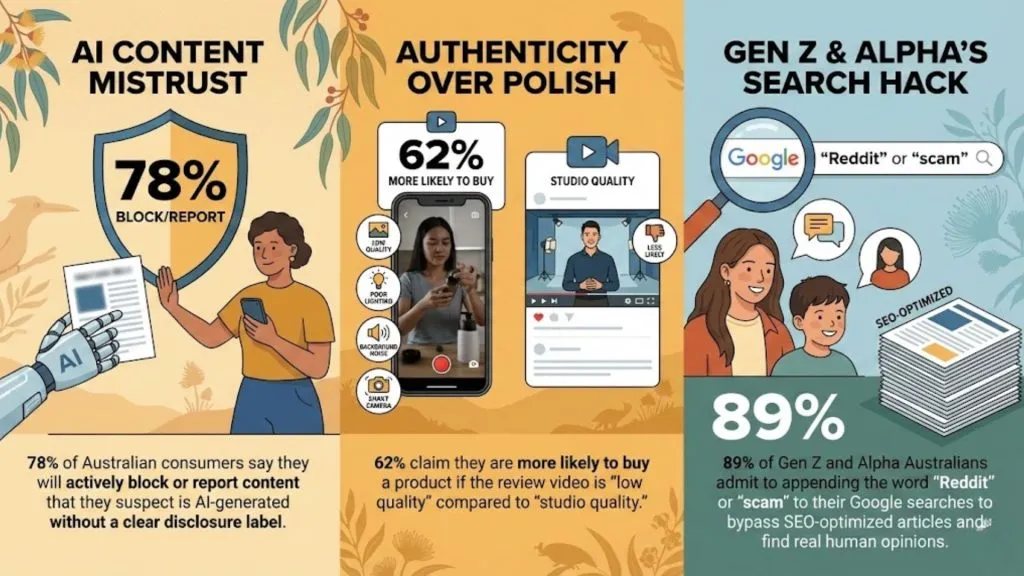
The numbers paint a brutal picture for traditional advertisers.
Part II: The Death of the “Curated Feed” and the Psychology of Grit
2.1 The Evolution of UGC: From Staged to Raw
In the early 2020s, User Generated Content (UGC) was often treated as a cheap alternative to professional production. Brands would hire creators to act like customers. They would send a brief: “Hold the bottle next to your face, smile, and say these three key benefits. Good lighting is a must.”
By 2026, consumers have learned to decode this “Staged UGC” as easily as they spot a deepfake. They recognize the “Influencer Voice”- that specific cadence and pitch used when someone is selling something.
The result is a shift toward “Grit”- content that retains the rough edges of reality. This is not just an aesthetic choice; it is a psychological necessity.
2.2 The “Pratfall Effect” in Marketing
Psychologically, this shift is explained by the Pratfall Effect, a phenomenon where a competent person’s likability increases when they make a mistake or show a flaw. In 2026, this applies to brands.
When a brand presents itself as perfect, it creates distance. When a brand (or a creator representing a brand) shows vulnerability, it creates intimacy.
2.3 Comprehensive Case Study: The “Unboxing” vs. The “Emptying”
To understand the financial impact of this shift, consider a documented A/B test conducted by a leading Australian supplement brand, VitalOz, in late 2025.
The Objective: Launch a new magnesium powder for sleep.
Campaign A (The Old Way - “The Polished approach”):
- Talent: A macro-influencer (500k followers), known for her wellness aesthetic.
- Creative: Filmed in a sunlit, minimalist kitchen. The influencer wears matching activewear. She unboxes a fresh tub, peels back the foil perfectly, smiles, reads the key ingredients (Glycinate, Citrate), and takes a sip from a glass with condensation on it.
- Script: “I love this product because it helps me sleep so well. It’s delicious.”
Campaign B (The 2026 Way - “The Grit approach”):
- Talent: A nano-influencer (1,200 followers), a FIFO (Fly-In-Fly-Out) worker in Western Australia living in a donga (transportable housing).
- Creative: Filmed at 5:00 AM under harsh fluorescent light. The video is grainy. The tub is empty. He shakes the last few grains into a plastic shaker.
- Script: “Bloody hell, finished it already. Look, it tastes a bit chalky if you don’t mix it right- you gotta shake it hard- but it’s the only thing that kept me asleep while the drillers were working outside.”
The Results:
- Campaign A: 0.8% Click-Through Rate (CTR), $42 Cost Per Acquisition (CPA).
- Campaign B: 3.8% CTR, $9 Cost Per Acquisition.
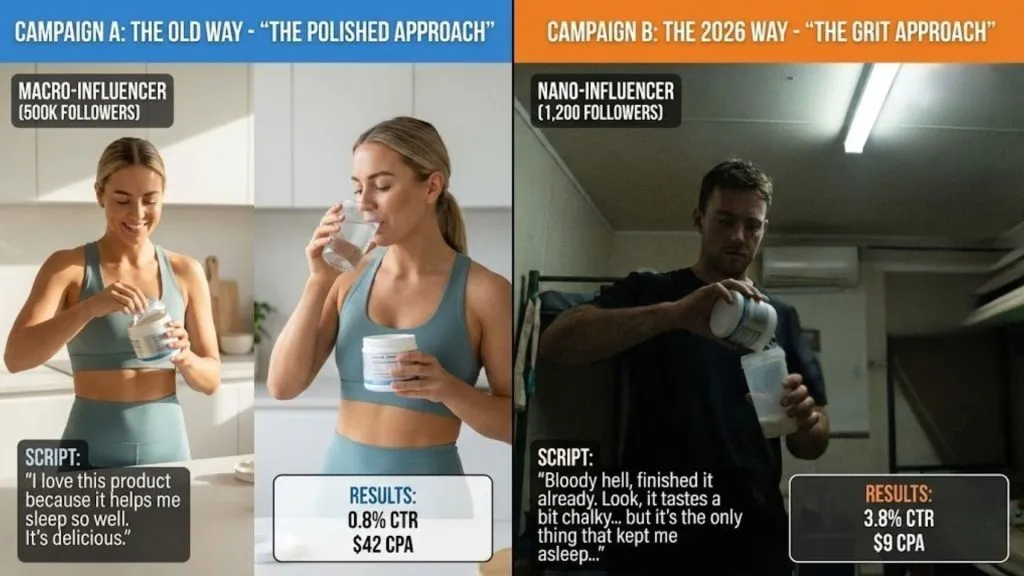
The “Negative Review” or the “Nuanced Review” is a stronger sales tool than the 5-star rave.
Analysis: Why did Campaign B win by such a landslide?
- Visual Proof of Consumption: An empty tub proves the product was actually used, not just promoted.
- The “Credibility Anchor”: The criticism of the texture (“chalky”) acted as an anchor for truth. Because he admitted a flaw, the audience believed the benefit (sleep). If he had said it tasted perfect and worked perfect, the brain would classify it as an ad. By saying it tasted bad but worked great, the brain classifies it as a recommendation.
- Relatability: The setting validated the use case.
In 2026, the “Negative Review” or the “Nuanced Review” is a stronger sales tool than the 5-star rave. Consumers are searching for the trade-off. They want to know the “catch” so they can decide if they can live with it.
Part III: The Architecture of Trust: Ecosystems Over Algorithms
3.1 The Crisis of Discoverability
As social media algorithms become increasingly flooded with AI-generated content, Australian businesses are facing a crisis of discoverability.
In the past, you built a website and did SEO. But in 2026, Google’s Search Generative Experience (SGE) often answers questions without sending traffic to websites. Furthermore, “SEO Spam” sites generated by AI have clogged the search results.
How do you prove you are a real business, with real people, offering real experiences? How do you distinguish a legitimate tour operator in Cairns from a scam website set up by a bot farm in a different continent?
This has led to the resurgence of Verified Ecosystems.
3.2 The Return of the Gatekeepers
We are seeing a migration away from the “Open Web” toward “Gated Communities” and specialized platforms. These platforms act as “Trust Anchors.”
This is where platforms like Australia Experiences have transitioned from being simple directories to becoming essential “Trust Infrastructures” for the Australian market.
In a digital landscape where a scam website can be generated in seconds, the mere existence of a digital storefront is no longer proof of legitimacy. Consumers are turning to platforms that offer a layer of vetting.
3.3 The Digital Passport Strategy
When a traveler looks for a winery in the Barossa Valley or a shark dive in Port Lincoln, they are bypassing the noise of TikTok (where a viral video might be three years old or totally staged) and looking for a centralized hub of verified businesses.
For an Australian business in 2026, being listed on a platform like Australia Experiences is the digital equivalent of having a physical “Open” sign on the door or a health inspection certificate in the window. It signals three critical factors to the consumer:
- Existence: “We are a registered Australian business with a verifiable ABN (Australian Business Number).”
- Curation: “We are part of a collective ecosystem, not a fly-by-night drop-shipping operation.”
- Community: “We are vetted by the industry.”
Strategic Takeaway: The strategy for 2026 is not “Be everywhere.” It is “Be somewhere trusted.” Businesses must anchor themselves to these high-authority domains to signal to both consumers and search engines that they are legitimate entities.
Part IV: EGC, The Employee Generated Revolution
4.1 The Collapse of Influence
If the Influencer bubble has not burst, it has certainly leaked. The cost-per-acquisition (CPA) for influencer marketing in Australia rose by 35% between 2024 and 2026. Meanwhile, the trust in “paid spokespeople” dropped.
Who do people trust? The technical term used by sociologists is “Technical Expert” or “A person like yourself.” This has given birth to the EGC (Employee Generated Content) movement.
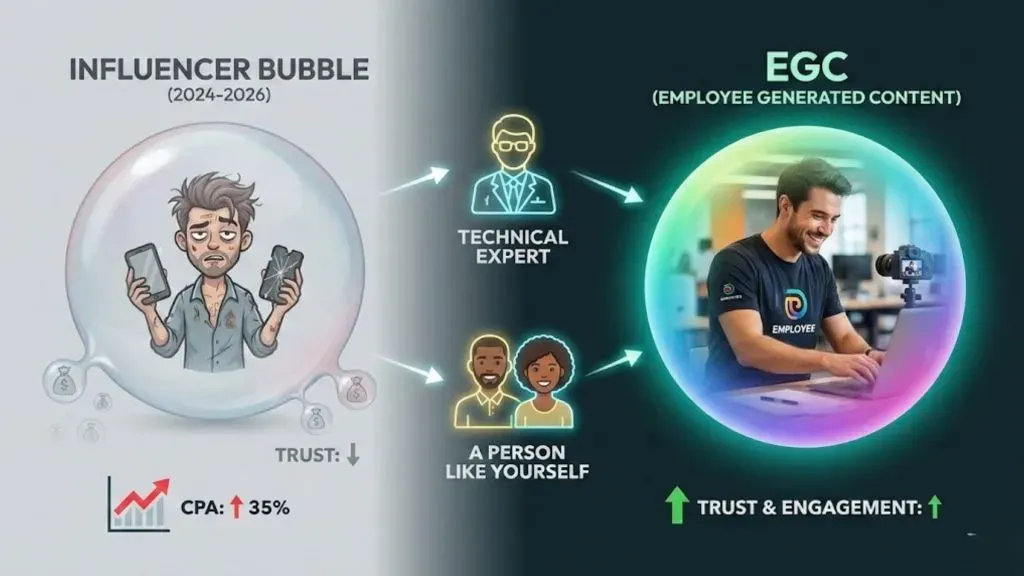
If the Influencer bubble has not burst, it has certainly leaked.
4.2 The “Inside-Out” Marketing Model
Australian brands like Mecca (cosmetics) and Bunnings (hardware) were early pioneers of this, but by 2026, it is the standard for B2B and service-based businesses.
Business owners are handing the cameras to their staff. Not the marketing team- the actual staff.
- The barista explaining why the beans taste different today because of the humidity.
- The warehouse manager showing how they pack an order so it doesn’t break.
- The receptionist showing the chaos of a Monday morning.
- The tour guide showing the mud on their boots after a trek.
Data Insight: LinkedIn Australia’s 2025 report showed that posts shared by employees see 8x more engagement than content shared by brand channels. Furthermore, leads generated through employee advocacy convert 7x more frequently.
4.3 Why EGC Wins in Australia
It taps into the egalitarian nature of Australian society. We like to see the “workers,” not just the “bosses.” EGC humanizes the corporation. It gives the brand a face, a voice, and yes- flaws.
A video of a staff member dropping a box, laughing, picking it up, and then explaining how they handle returns is infinitely more valuable than a polished corporate video about “Logistics Excellence.”
Implementation Strategy: Do not give your employees a script. Give them “Guardrails.”
- Script: “Say exactly this.” (Result: Robotic, Untrustworthy)
- Guardrail: “Show us how you solve problem X, keep it under 60 seconds, and don’t swear.” (Result: Authentic, Engaging)
Part V: The New SEO (Search Experience Optimization)
5.1 Redefining Search
For the past decade, SEO meant “Search Engine Optimization”- writing text for Google’s robots. In 2026, SEO means “Search Experience Optimization”- creating content that survives the scrutiny of human skepticism.
The text-based search is dying. The Visual Search is born. When a potential customer in Sydney or Melbourne considers a business, their journey now looks like this:
- Discovery (Passive): They see a short-form video (TikTok/Reels/Shorts).
- Skepticism (Active): They assume it is an ad or a fake.
- Verification (The “Reddit Test”): They append the word “Reddit” or “Review” to their search queries. e.g., “Best cafe Melbourne CBD reddit” or “Is [Brand Name] legit whirlpool forums”.
- Visual Confirmation: They look for “Tagged Photos” on Instagram/Facebook or Google Maps to see what regular people (not the brand) are posting.
5.2 The Strategy of “Digital Breadcrumbs”
To win in this environment, businesses must leave a trail of authentic digital breadcrumbs.
- Encourage “Ugly” Reviews: Never delete a 3-star review that says the coffee was too hot. Reply to it. That review proves you are real. A profile with only 5-star reviews is a red flag for “Bot Farm.”
- Leverage Third-Party Validation: Ensure your presence on verified ecosystems (like the aforementioned Australia Experiences) is active and up to date. These high-authority domain backlinks are crucial signals to AI search engines that you are a legitimate entity worth citing.
- Visual SEO: Ensure that when someone searches your brand name + “real”, they find video content, not just text.
Part VI: The Legal and Ethical Landscape of 2026
6.1 The Regulatory Crackdown
We cannot discuss the future of marketing without addressing the elephant in the room: Regulation. By 2026, the Australian Competition and Consumer Commission (ACCC) has tightened its grip on digital advertising.
Following the “Influencer crackdown” of 2024, 2026 sees the introduction of the “Truth in Synthesis” laws.
- Mandatory AI Labeling: Any content significantly altered or generated by AI must be watermarked.
- The “Humanity Right”: Consumers have a right to know if they are interacting with a human or a bot.
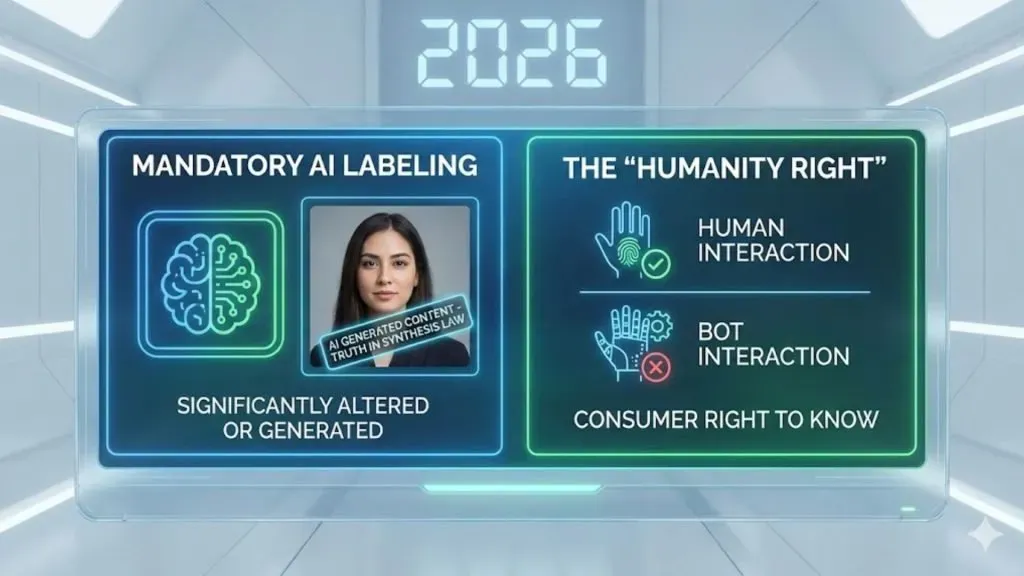
The Legal and Ethical Landscape of 2026
6.2 The Compliance Advantage
Smart businesses are using compliance as a marketing tool. Instead of hiding the fact that they use real humans, they are broadcasting it. We are seeing badges on websites: “100% Human Support” or “Content Created by Humans.”
This regulatory environment makes platforms like Australia Experiences even more critical. Because these platforms vet their listings, they act as a shield against regulatory scrutiny. Being listed there is proof of “Commercial Reality.”
Part VII: The Economics of “Lo-Fi”
7.1 The Financial Argument
Perhaps the most compelling argument for this shift is not cultural or legal, but financial. The “Polished” aesthetic is expensive. The “Authentic” aesthetic is cost-efficient, but requires bravery.
7.2 The ROI of Raw: A Financial Breakdown
Let’s look at the Cost Per Creative (CPC) vs. Return on Ad Spend (ROAS).
| Metric | Traditional Production (Studio) | 2026 "Lo-Fi" UGC/EGC |
| Production Cost | $5,000 - $15,000 | $0 - $500 (Cost of product + labor time) |
| Turnaround Time | 3-4 Weeks | 2-4 Hours |
| Ad Fatigue | 1-2 Weeks (Audience ignores it) | 3-5 Days (Requires high volume) |
| Trust Score (CTR) | 0.8% | 2.5% |
| Conversion Rate | 1.2% | 3.8% |
| Customer LTV | Moderate (Bought the hype) | High (Bought the reality) |
(Source: Aggregated data from Meta & TikTok Business Insights, Australia Region, Q4 2025)
The data suggests that while “Lo-Fi” content burns out faster (people get bored of the specific video quickly), it is so cheap to produce that businesses can churn out dozens of variations per week. This “High Velocity, Low Fidelity” strategy is the only way to beat the algorithms in 2026.
7.3 The “Slick Tax” vs. The “Relevance Discount”
There is now a “Slick Tax” in marketing. The more money you spend making something look like an ad (high production value, color grading, perfect sound), the more you have to pay the platforms (Meta/Google) to force people to watch it. You are literally paying a penalty for looking like an ad.
Conversely, content that looks native, raw, and human enjoys a “Relevance Discount.” Platforms serve it organically because it keeps users on the app. It feels like entertainment, not interruption.
Part VIII: Future Outlook - The “Phygital” Convergence
As we look toward the end of 2026 and into 2027, the line between digital marketing and physical experience will blur completely.
We are seeing the rise of “Proof of Attendance” marketing. Consumers want to physically be somewhere to prove they exist. This will drive a massive boom for the “Experience Economy”- travel, dining, events.
This brings us back to the core thesis: Validation. In a world where I can visit Paris in VR or chat with an AI girlfriend, the act of physically standing in a winery in Margaret River, feeling the wind, and tasting the wine becomes the ultimate luxury.
Marketing’s job is no longer to simulate that experience, but to verify that it exists and to give the consumer the confidence to book it.
Conclusion: Brave New World
The Marketing landscape of Australia in 2026 is not for the faint-hearted. It requires a fundamental letting go of control.
For decades, Brand Managers were taught to protect the brand guidelines, to control the narrative, to ensure every pixel was perfect. To survive 2026, you must do the opposite. You must hand the narrative over to your customers and your employees.
You must embrace the shaky camera, the unscripted moment, and the negative review. You must move your budget from “Production” to “Verification.” You must anchor your business in verified ecosystems like Australia Experiences rather than relying solely on fleeting algorithmic favor.
In a world of artificial intelligence, the only competitive advantage left is natural stupidity- or rather, natural humanity. The messiness, the unpredictability, and the undeniable reality of the human experience.
Authenticity is no longer a buzzword. It is the only currency that the algorithm cannot devalue.