
In 2025, around 75.6% of brands plan to dedicate some portion of their marketing budget to influencer marketing. However, with a brand manager spending only 6 seconds per profile, your first impression is your only impression. To win, you need more than just photos; you need a strategic business asset. Leading creators are now pairing their updated portfolios with professional networks like Australia Experiences to ensure they stay visible to the right decision-makers.
If your portfolio is still stuck in 2024, you’re missing out on the booming Australian creator economy. This guide breaks down the high-converting Media Kit Template 2026 designed specifically for the Australian market.
Key Takeaways: The 2026 Strategy
** 2026 Market Shift:** 75% of Australian brands are moving budgets to micro-creators; a professional, data-backed Media Kit is now the entry requirement.
️ The 6-Second Rule: Brand managers scan profiles instantly. Your value proposition and local relevance must be visible at first glance.
** Hyper-Local Focus:** You must prove an Australian audience (Sydney, Melbourne, etc.) and list all rates in AUD to win local contracts.
** Quality Over Vanity:** Brands prioritize Saves, Shares, and Retention Rates over “Likes” as they correlate directly with ROI.
** Strategic Networking:** Beyond a great kit, joining ecosystems like Australia Experiences is the fastest way to get discovered by premium brands.
1. Why Your 2026 Media Kit is Already Obsolete
The Australian influencer landscape has matured into a professional ecosystem where accountability is the new currency. In 2026, brands are no longer impressed by “vanity metrics” such as a high follower count or a curated grid of filtered photos. Today’s marketing managers are looking for Hyper-Local Authority and Verifiable ROI. They are under pressure to justify every dollar spent to their stakeholders, which means they need creators who can act as data-driven marketing consultants.
Why Your 2026 Media Kit is Already Obsolete
The “Aussie Factor” in Brand Partnerships
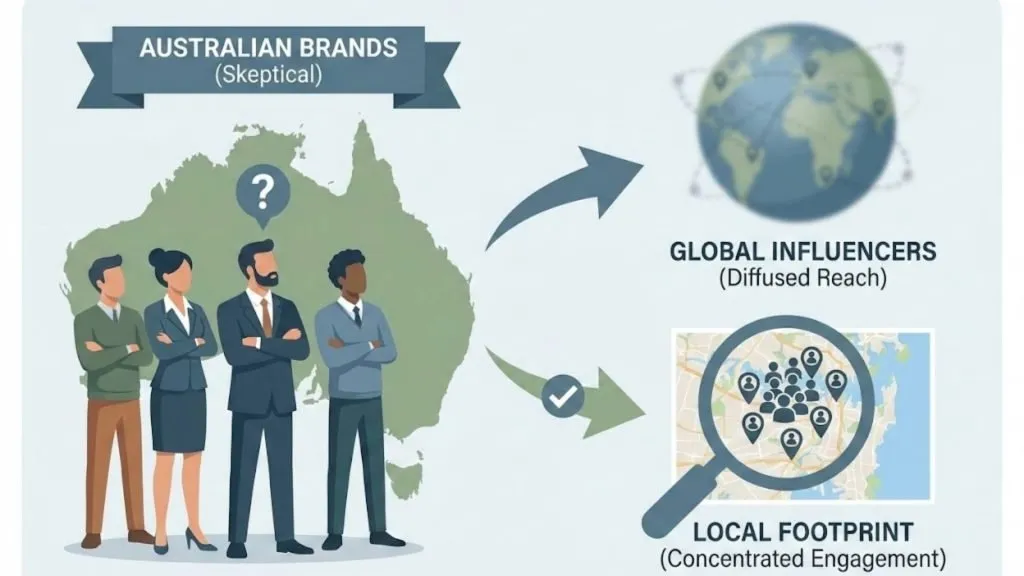
Australian brands have become increasingly skeptical of “global” influencers who lack a concentrated local footprint. The “Aussie Factor” is a specific demand for cultural relevance. A creator might have a million followers, but if only 5% of them are based in Australia, a local brand will see very little value. They want to know: Do you actually influence the people who walk into my stores or visit my .com.au domain? Why brands are shifting focus in 2026:
- Logistics & Shipping: Brands prefer creators whose audience can actually access their products without international shipping hurdles.
- Local Events: Agencies in Sydney and Melbourne prioritize creators who can attend physical launches and pop-up events.
- Community Trust: Australian consumers are more likely to trust recommendations from someone who understands the local climate, seasons, and lifestyle.
2. Critical Data Points Defining the 2026 Australian Market
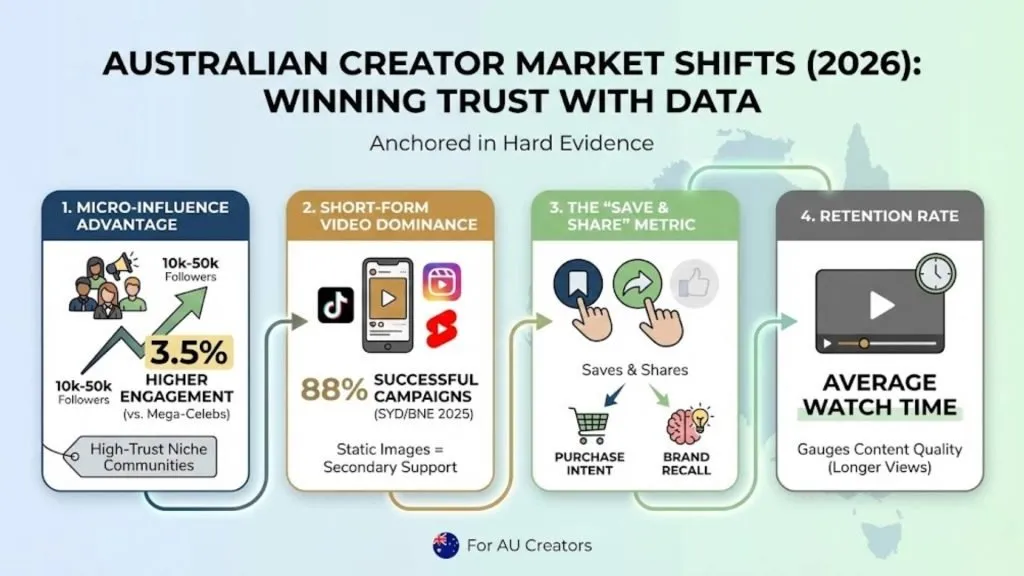
To rank at the top of search results and win brand trust, your content must be anchored in hard evidence. The 2026 market is defined by several key data shifts that every Australian creator must incorporate into their media kit:
- The Micro-Influence Advantage: Creators with 10k, 50k followers in Australia see a 3.5% higher engagement rate than mega-celebrities. Brands now value these high-trust niche communities.
- Short-Form Video Dominance: Approximately 88% of successful marketing campaigns in Sydney and Brisbane in 2025 utilized TikTok, Reels, or YouTube Shorts. Static images have become secondary support assets.
- The “Save & Share” Metric: Australian brands now prioritize “Saves” and “Shares” over “Likes.” These actions correlate much more directly with purchase intent and long-term brand recall in the AU consumer market.
- Retention Rate: Brands are now looking at how long people watch your videos (Average Watch Time) to gauge content quality.
Critical Data Points Defining the 2026 Australian Market
3. Essential Elements of a High-Converting Media Kit Template 2026
A winning 2026 Media Kit should be a sleek, high-performance document that functions as a professional resume. It should be available as a high-quality PDF for email attachments and a live, responsive link for quick mobile viewing. Here is a deep dive into the strategic sections your template must include.
The “Vibe Check”: Building Instant Credibility
The header and bio section is your digital handshake. In the Australian market, the visual “vibe” should be bright, authentic, and often grounded in the natural beauty of the country. Whether you are a city-based tech reviewer or a coastal lifestyle creator, your imagery should feel accessible rather than overly polished.
When writing your bio, avoid the temptation to tell your entire life story. Instead, focus on a three-sentence power statement: define who you are, state your specific niche, and clearly articulate your unique value proposition. For example, instead of saying “I love fashion,” try “Helping Sydney-based Gen Z find sustainable fashion alternatives through high-energy styling videos.” This tells the brand exactly who you reach and why you matter.
Hyper-Local Audience Insights: The Heart of the Pitch
This is where you prove your worth as an Australian creator. You must go beyond simple demographics and provide a granular breakdown of where your audience lives. Use clear, modern charts to display your location data, specifically highlighting your percentage of followers in Australia versus the rest of the world.
Brands appreciate it when you break down your audience by major cities like Sydney, Melbourne, Brisbane, Perth, and Adelaide. If a brand is running a pop-up event in Surry Hills, they need to see that you have a significant following in New South Wales. Additionally, providing data on audience interests, such as a “60% interest in Australian domestic travel”, allows the brand to see if your community’s passions align with their product offerings.
Multi-Platform Performance Metrics
Transparency is non-negotiable in 2026. Brands expect to see your average performance metrics over the last 30 to 60 days to ensure they aren’t looking at a “one-hit-wonder” post. For TikTok, focus on your average views per video and your average completion rate, as this proves your content is engaging enough to keep people watching until the end.
On Instagram, “Average Reach per Reel” and “Story Views” remain the golden metrics for Australian brands. Stories are particularly important for conversion-driven campaigns because they allow for direct link stickers. For YouTube Shorts, highlighting subscriber growth and click-through rates demonstrates that you are building a loyal, long-term audience that is willing to leave the platform to visit a brand’s website.
Case Studies and The Power of Social Proof
Instead of cluttering your media kit with dozens of tiny brand logos, choose two or three high-impact collaborations to highlight as mini case studies. This narrative approach allows you to walk the brand manager through your creative process and the tangible results you achieved.
Clearly state the challenge the brand was facing, the creative solution you provided, and the specific result using hard numbers. For instance, you might state: “Partnered with a Melbourne-based skincare brand to launch their new serum, resulting in a 15% increase in website traffic and 200 direct sales within the first 48 hours.” This proves you aren’t just a creator; you are a catalyst for business growth.
4. Setting Your Rates: Navigating the 2026 AUD Rate Card
Pricing in Australia is influenced by the high cost of living and legal requirements. Avoid “Price on Request” to reduce friction during the initial screening process.
| Service Type | Micro-Creator (10k-50k) | Mid-Tier (50k-150k) |
| 1x Dedicated TikTok/Reel | $450 - $850 AUD | $1,200 - $2,500 AUD |
| 1x IG Story Set (3 frames) | $200 - $400 AUD | $600 - $1,200 AUD |
| UGC Content (No Posting) | $350+ per video | $800+ per video |
| Whitelisting/Ad Usage | +20-30% of base fee | +20-30% of base fee |
Factors that justify higher rates:
- Exclusivity: If the brand asks you not to work with competitors for 3 months.
- Usage Rights: If the brand wants to use your face in their paid Meta/TikTok ads.
- Fast Turnaround: If they need the content delivered in less than 48 hours.
- Production Value: If you are using professional cinema cameras or complex editing.
5. Design Principles: The Psychology of Professionalism
The visual language of your media kit says as much about you as the data within it. In 2026, the trend has moved away from cluttered, “maximalist” designs toward a philosophy of Functional Minimalism. Your goal is to make the information as easy to consume as possible.
Mobile-First and Accessible Design
Statistics show that approximately 70% of Australian brand managers will first view your media kit on their smartphones. This means your design must be mobile-responsive. Use large, legible fonts and ensure that any buttons or links are “thumb-friendly”, meaning they are easy to click on a small screen.
Accessibility is also a key consideration for modern Australian corporations. Use high-contrast color palettes and clean, Sans Serif fonts like Montserrat or Lato. These fonts provide an “Aussie style” that feels modern, professional, and approachable. Avoid overly decorative scripts that are difficult to read at a glance.
The “Live” Element of Modern Kits
One of the most innovative features of a 2026 Media Kit is the inclusion of a “Live” element. By including a QR code or a direct link to a live dashboard (such as a Notion page or a specialized creator platform), you provide brands with real-time access to your metrics. This level of transparency is incredibly rare and signals to the brand that you have nothing to hide and are fully confident in your ongoing performance.
6. Mastering the Pitch: Building Relationships in the Australian Market
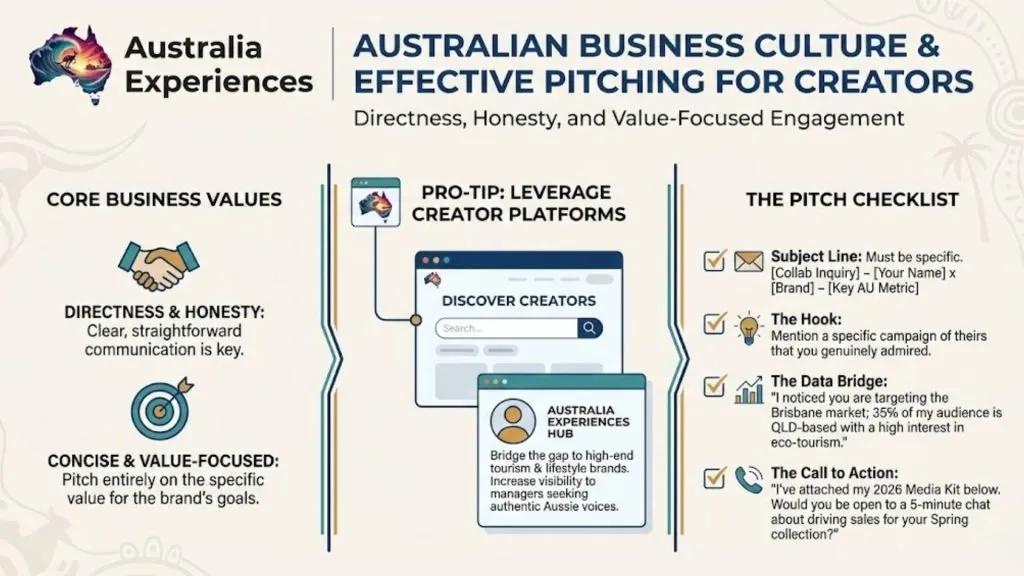
Australian business culture values directness and honesty. Your pitch should be concise and focused entirely on the value you can bring to the brand’s specific goals.
Australian business culture values directness and honesty.
Pro-Tip: Leverage Creator Platforms Once your Media Kit is ready, you need a place where brands can discover you. Platforms like Australia Experiences are specifically designed to bridge the gap between talented creators and high-end Australian tourism and lifestyle brands. Listing your profile on dedicated local hubs increases your visibility to managers who are already looking for authentic Aussie voices.
The Pitch Checklist:
- Subject Line: Must be specific. [Collab Inquiry], [Your Name] x [Brand], [Key AU Metric].
- The Hook: Mention a specific campaign of theirs that you genuinely admired.
- The Data Bridge: “I noticed you are targeting the Brisbane market; 35% of my audience is QLD-based with a high interest in eco-tourism.”
- The Call to Action: “I’ve attached my 2026 Media Kit below. Would you be open to a 5-minute chat about driving sales for your Spring collection?“
7. Legalities and Compliance for Australian Creators
Professionalism in 2026 requires a deep understanding of Australian regulations. Failing to mention these can make you look like an amateur.
- ACCC Guidelines: You must clearly disclose sponsored content using #Ad or #PaidPartnership. Explicitly stating your commitment to transparency in your Media Kit builds trust with corporate brands.
- TGA Regulations: If you work in the health, beauty, or wellness sectors, you must ensure your claims comply with Therapeutic Goods Administration rules regarding “before and after” photos and testimonials.
- GST & Invoicing: If you are an Australian-registered business with an ABN, specify if your rates include GST. Brands expect professional tax invoices.
Conclusion: Taking the Lead in the 2026 Creator Economy
The Australian creator economy is no longer a hobby, it’s a professional industry. By utilizing a data-driven Media Kit Template 2026, you position yourself as a business partner rather than just a poster. Success in 2026 is reserved for those who can bridge the gap between creative storytelling and analytical results.
Ready to turn your content into a career? Stop waiting for brands to land in your DMs. Apply to Join Australia Experiences today and put your professional Media Kit in front of the leading tourism and lifestyle brands across Australia. Start building your professional brand and secure the deals you deserve.
8. FAQ: Answering the Concerns of Australian Brand Managers
1. Where Should I Host My Media Kit?
A PDF is standard for emails, but a hosted link (via Canva, Notion, or your own website) is better for social media bios.
2. Where Can I Find Brands Looking for Creators in Australia?
Networking is key, but joining a community like Australia Experiences is the most efficient way to get your Media Kit in front of the right eyes in the lifestyle and experience sectors.
3. Do I Need a Separate UGC Portfolio?
Yes. A Media Kit shows your audience reach, while a UGC Portfolio shows your production skills. If you offer both, have two separate documents or two distinct sections.
4. How Often Should I Update My Stats?
In the fast-moving 2026 market, update your metrics monthly. An outdated Media Kit suggests a stagnant or inactive account.