
Australia Day has passed, and the “Back to School” rush marks a critical pivot point for marketing managers across Sydney, Melbourne, and Brisbane. As reports from the summer holiday campaigns roll in, filled with impressive reach metrics and engagement stats, a fundamental disconnect remains. While social media numbers trend upward, Finance Directors are asking a harder question: Did this actually make money?
With advertising budgets tightening, the era of accepting “Brand Awareness” as a standalone KPI is ending. In this guide, Australia Experiences will analyzes how to audit your recent campaigns and provides a rigorous framework for calculating actual Influencer Marketing ROI Australian market.
The Post-Australia Day Reality Check
The period spanning from Boxing Day through to Australia Day represents one of the highest spending windows in the Australian retail calendar. Brands pour significant resources into partnerships with creators to capture the attention of Australians enjoying their summer break. Now that the dust has settled, we are left with a massive amount of data, but often very little insight.

Boxing Day through to Australia Day represents one of the highest spending windows
The Problem with Vanity Metrics in 2026
For too long, Australian businesses have relied on “Vanity Metrics”, likes, shares, comments, and follower counts, as the primary indicators of success. While these metrics provide a snapshot of content resonance, they are often misleading proxies for business health. A verified influencer in Byron Bay posting a photo with your product might generate 15,000 likes. On the surface, this appears to be a viral success. However, if those 15,000 likes are primarily from users in the United States or Europe who cannot purchase your product, or from bots and engagement pods, the commercial value to your Australian business is effectively zero.
Furthermore, algorithmic shifts on platforms like TikTok and Instagram Reels have decoupled follower counts from reach. High engagement rates no longer guarantee conversion. According to the Digital 2025 Australia report, average engagement rates on Instagram have dipped, meaning a “double tap” rarely translates into immediate purchase intent without a structured conversion funnel. If your post-campaign report focuses solely on “Engagement Rate” without linking it to “Cost Per Acquisition” (CPA), you are likely obscuring the true performance of your marketing spend.
The “Long Weekend” Distortion
Analyzing data from the Australia Day period requires a nuanced understanding of local consumer behavior. Because the holiday falls in peak summer, often resulting in a long weekend, online purchasing behavior shifts. Australians are outdoors, attending barbecues, or at the beach, meaning screen time increases but “intent to buy” often decreases during the daylight hours of the holiday itself.
A common mistake marketers make is looking at the conversion data strictly on January 26th and deeming the campaign a failure due to low direct sales. However, the “Add to Cart” actions often occur in the days following the holiday, known as the “return to routine” window. A sophisticated ROI analysis must account for this attribution lag. If you are only measuring immediate clicks, you are likely undervaluing your influencer partnerships.
Calculating True ROI: The Revenue-First Approach
To determine if your campaign was truly successful, you must move beyond the “Earned Media Value” (EMV) estimates that many agencies provide. EMV assigns an arbitrary dollar value to a like or comment, which does not reflect cash in the bank. Instead, you need to calculate actual ROI using a strict financial formula.
The Ultimate Success Metric: ROI
ROI =
(Revenue - Cost)
Cost
× 100
How to Calculate
- Revenue: Total sales directly tracked from the influencer (via Discount Codes or UTM Links).
- Cost: Total investment (Influencer Fee + Product COGS + Shipping + Agency Fees).
** Pro Insight:** A positive ROI (above 0%) means you are profitable. In Influencer Marketing, an ROI of 300%+ (3:1 return) is considered a strong benchmark for a successful campaign.
While the formula looks simple, the complexity lies in how accurately you define “Revenue” and “Cost” within the Australian operating context.
Defining Total Cost of Campaign (The Denominator)
Many marketers mistakenly calculate ROI based solely on the influencer’s booking fee. This leads to an artificially inflated ROI percentage. To get a truthful number, you must account for every dollar that left your business to facilitate the campaign.
First, consider the Talent Fees. This is the direct payment made to the influencer. In Australia, if you are working with professional talent or agencies, this fee likely attracts a 10% GST (Goods and Services Tax). While businesses can claim GST credits, it is crucial to ensure your budgeting reflects the cash flow reality.
Second, you must factor in Production and Product Costs (COGS). If you sent a seeding kit containing $200 worth of skincare products to 50 influencers, the cost is not zero. You must account for the Cost of Goods Sold (COGS), not the retail price. Additionally, logistics in Australia are expensive. Shipping parcels from a warehouse in Western Sydney to influencers in Perth or regional Queensland incurs significant postage fees. These logistics costs must be added to the campaign expense line.
Third, include Agency and Management Fees. If you utilized a talent management agency or a PR firm to coordinate the Australia Day campaign, their retainer or project fee is part of the cost of acquisition. If you spent $5,000 on influencers and $3,000 on agency management fees, your base cost is $8,000, not $5,000.
Finally, do not overlook Paid Amplification. In 2026, organic reach is unreliable. Smart brands often put paid media budget behind influencer content (Whitelisting). If you spent $2,000 boosting the influencer’s post to a targeted audience in Melbourne and Sydney, this must be added to the total cost.
Defining Attributed Revenue (The Numerator)
Attributing revenue is the most challenging aspect of influencer marketing. If you claim all sales during the campaign period were driven by influencers, you are lying to yourself. You must isolate the revenue that is directly or indirectly attributable to the creator.
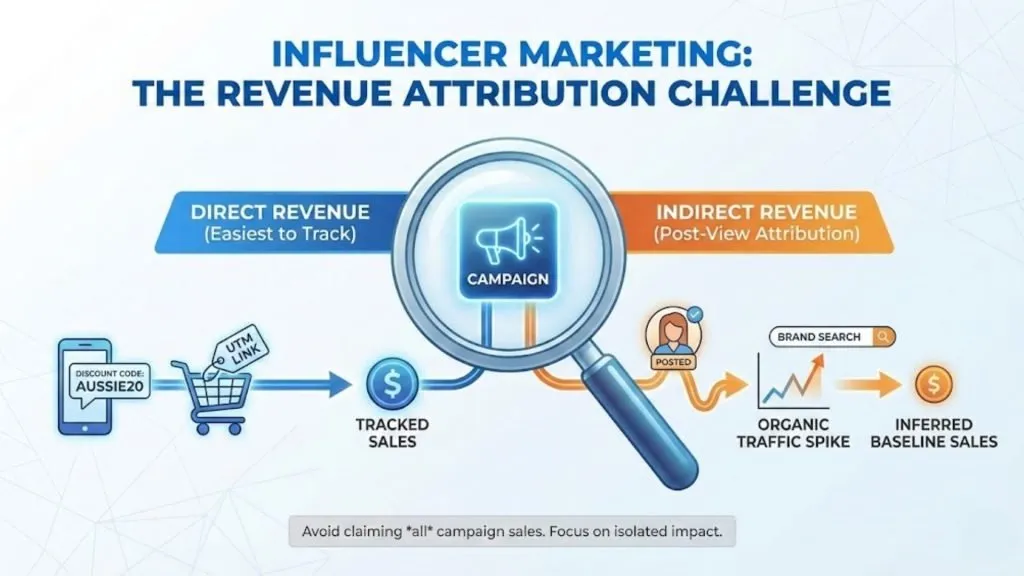
Defining Attributed Revenue (The Numerator)
Direct revenue is the easiest to track. This comes from unique discount codes (e.g., AUSSIE20) or specific UTM links placed in the influencer’s bio. However, relying solely on codes often underreports success, as many users view the content and then search for the brand on Google later. This is where “post-view attribution” becomes critical. By analyzing your direct traffic and organic search spikes during the exact hours the influencer posted, you can infer a baseline of indirect revenue.
For a strict ROI calculation, it is safer to be conservative. Only count revenue that can be verified through tracking pixels, codes, or immediate click-throughs. If the resulting ROI is positive using conservative metrics, you know the campaign was genuinely profitable.
Attribution Models for the Australian Market
Understanding how a customer journey moves from a creator’s post to a checkout page is vital for proving value. In Australia, the path to purchase is rarely linear, especially during holiday periods.
The Limitation of Last-Click Attribution
Most standard analytics setups, such as Google Analytics 4 (GA4) in its default state, use a “last-click” attribution model. This means if a customer sees an influencer’s post on Instagram, clicks the link, but then leaves the site to search for a coupon code or read a review, and finally returns via a Google Search ad to buy, the influencer gets zero credit. The sale is attributed to Google Ads.
For your Post-Australia Day audit, this is likely suppressing your ROI figures. Influencers often sit at the “Awareness” and “Consideration” stages of the funnel. To calculate a fairer ROI, you should look at “Assisted Conversions” in your analytics tools. This metric shows how many times an influencer was part of the journey, even if they were not the final click. Brands that ignore assisted conversions often fire their best-performing influencers because they fail to see the groundwork those creators laid for the final sale.
Leveraging Unique Discount Codes
In the Australian market, the unique discount code remains the gold standard for tracking, despite its primitive nature. It circumvents privacy changes (like iOS tracking transparency) because the tracking mechanism happens at the checkout cart, which the merchant controls.
However, a common pitfall is code leakage. If an influencer’s code SUMMER20 gets shared on a coupon scraping site like OzBargain, you might see a massive spike in “attributed” revenue that didn’t actually come from the influencer’s audience. To protect the integrity of your ROI data, analytics teams need to monitor the traffic source of code usage. If the traffic is coming from a coupon site rather than Instagram or TikTok, that revenue should be discounted from the influencer’s ROI calculation.
Analyzing Your Australia Day Campaign Data
Now that we have established the definitions and the math, let us look at how to interpret the specific data from your recent holiday campaign.
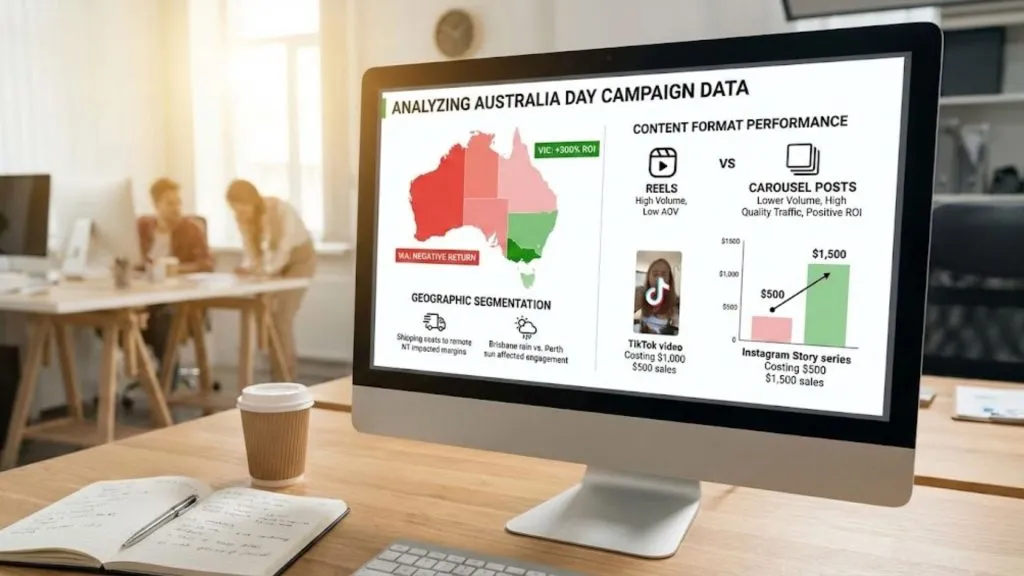
Analyzing Your Australia Day Campaign Data
Geographic Segmentation and Logistics
Australia is a continent-sized country with distinct market micro-climates. When analyzing your ROI, segment the data by state. A campaign might show a negative ROI overall, but a deep dive could reveal a 300% ROI in Victoria and a negative return in Western Australia.
This often happens due to shipping costs or local relevance. Perhaps your shipping offer was “Free Shipping Australia Wide,” but the cost of fulfilling orders to remote parts of the Northern Territory ate into your margins. Alternatively, the weather patterns during the Australia Day weekend varies wildly; it might have been raining in Brisbane while sunny in Perth. Influencer content featuring outdoor beach scenes would convert poorly in a rain-soaked city. By segmenting your ROI geographically, you can refine your strategy for future campaigns, perhaps focusing budget only on the Eastern Seaboard states where logistics are cheaper and population density is higher.
Content Format Performance
Did your Reels outperform your static posts? Did long-form YouTube integrations drive higher average order value (AOV) than TikTok shorts? The data from this campaign should dictate your brief for the next one.
Current trends in Australia suggest that while short-form video drives volume (views), long-form content or “carousel” posts often drive higher quality traffic that stays on the site longer. Calculate the ROI specifically by content format. You may find that while a TikTok video cost $1,000 and drove 100,000 views, it resulted in $500 in sales (Negative ROI). Meanwhile, an Instagram Story series cost $500, drove only 2,000 views, but resulted in $1,500 in sales (Positive ROI). This insight is invaluable: it tells you that for your brand, “boring” high-intent formats make money, while viral formats just burn cash.
Strategic Adjustments for Easter and EOFY
The analysis of your Australia Day campaign is not just a retrospective exercise; it is the foundation for your strategy leading into Easter (April) and the critical End of Financial Year (EOFY) sales in June.
Shifting from CPM to CPA
Based on your findings, your upcoming briefs should shift the conversation with agencies and talent. Instead of negotiating based on CPM (Cost Per Mille / Cost per thousand views), start negotiating based on CPA targets.
If you know that your break-even CPA is $25 AUD, you can reverse-engineer your influencer selection. Look for creators who have high trust and authority rather than just high follower counts. “Micro-influencers” (10k-50k followers) in Australia often boast engagement rates significantly higher than macro-influencers. The Digital 2025 Australia report suggests that niche creators often command more purchasing power over their audience because the relationship is perceived as a friendship rather than a broadcast. For your Easter campaign, spending $5,000 across ten micro-influencers might yield a better ROI than spending $5,000 on one reality TV star.
To find these authentic connections, look beyond agency rosters. Exploring local business ecosystems via platforms like Australia Experiences can reveal the specific brands and operators that real communities are engaging with, helping you identify potential cross-promotion partners that amplify your influencer strategy.
Compliance and Trust
Finally, a note on the regulatory environment. The Australian Influencer Marketing Council (AiMCO) and the ACCC have tightened regulations regarding ad disclosure. In your analysis, check if the posts that had clear #Ad or #Sponsored disclosures performed differently from those that were more ambiguous.
Surprisingly, data often shows that compliant, clearly marked content performs better in terms of conversion. Australian consumers are savvy; they appreciate transparency. When a creator honestly reviews a product and discloses the partnership, the “Trust Metric” increases. High trust leads to high conversion. If your audit reveals that influencers who hid disclosures had lower conversion rates, it validates the strategy of enforcing strict compliance in your future contracts.
Conclusion
The post-Australia Day period is the perfect time to reset your influencer marketing strategy. The days of throwing product at anyone with a blue tick and hoping for the best are over. By ignoring vanity metrics and relentlessly focusing on the Revenue/Cost equation, Australian brands can turn influencer marketing from a questionable expense into a predictable revenue generator.
As you prepare for the rest of 2026, remember that a campaign with 1,000 likes and $10,000 in sales is infinitely more valuable than a campaign with 100,000 likes and $1,000 in sales. It is time to let the data, not the dopamine of social validation, drive your marketing decisions. Open your spreadsheets, calculate your true costs, and demand accountability from your metrics. And if you are looking for meaningful partnerships to start your next profitable campaign, explore the curated business community on Australia Experiences. Your bottom line will thank you.