
In the economic climate of 2025, Australian businesses face a critical dilemma: shrinking budgets versus rising customer acquisition costs. The era where a single celebrity endorsement guaranteed sales is fading, replaced by a consumer demand for authenticity over “Vanity Metrics.”
The question for SMEs is no longer like Micro vs. Macro Influencers: “should we use influencers?” but “who actually drives results?” In this guide, Australia Experiences will analyze why prioritizing a “quantity” of Micro-influencers over the “fame” of Macro-stars is proving to be the superior strategy for ROI and trust in the Australian market.
Key Strategic Insights
Trust over Fame: Due to “Tall Poppy Syndrome,” Australians trust relatable “mates” (Micro) far more than distant celebrities (Macro).
The “Swarm” Strategy: Allocating budget to 20 Micro-influencers often yields higher ROI and asset longevity than betting on 1 Macro star (Case Study: Koala).
Data Wins: Micro-influencers in Australia average 3.5% - 5% engagement, whereas Macro-influencers often drop below 2.5%.
Hybrid Approach: Use Macro for national “shouting” (Awareness) and Micro for local “whispering” (Conversion).
Strict Compliance: Adhering to the AANA Code of Ethics (clear disclosures) is non-negotiable and actually builds brand trust.
1. Decoding the Tiers: The Australian Context
Before diving into strategy, it is crucial to define what these tiers look like specifically within the Australian market. Our definitions often differ slightly from the US or UK markets due to our population size (approx. 27 million).
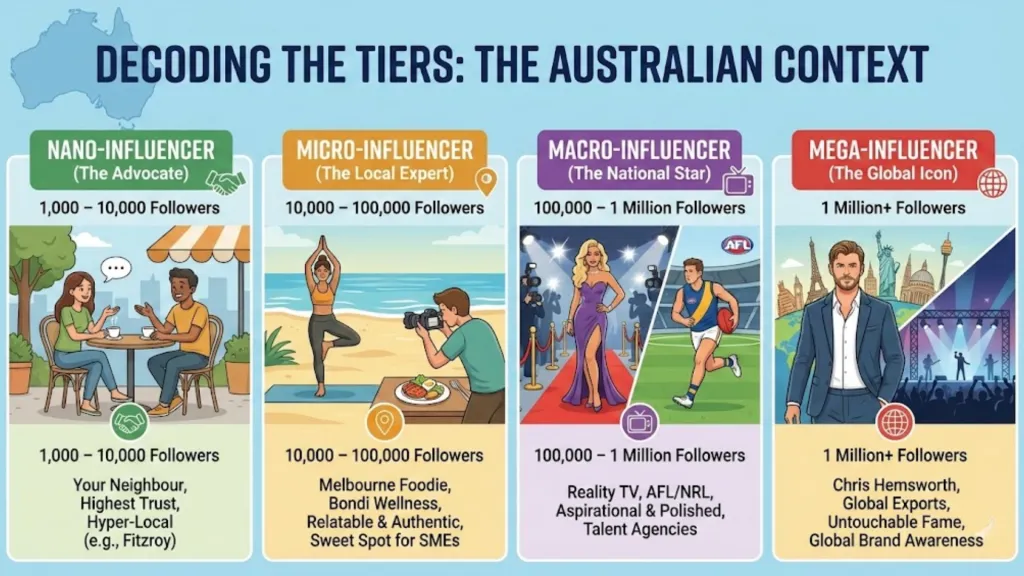
Decoding the Tiers: The Australian Context
The Nano-Influencer (The “Advocate”)
- Follower Count: 1,000-10,000.
- The Persona: Your neighbour, the local barista who knows everyone, or a university student with a cool style.
- The Value: They have the highest trust score. When they post, it’s not seen as an ad; it’s a recommendation from a friend. Perfect for hyper-local businesses (e.g., a new cafe in Fitzroy).
The Micro-Influencer (The “Local Expert”)
- Follower Count: 10,000-100,000.
- The Persona: These are the Melbourne foodies, the Bondi wellness instructors, the Perth mining-fifo-lifestyle bloggers, or the Tasmanian travel photographers. They are not famous in the traditional sense, but they are “famous” within their specific niche.
- The Vibe: Relatable, accessible, and authentic. They reply to comments. They live in suburbs that look like yours. They are the “sweet spot” for most SMEs.
The Macro-Influencer (The “National Star”)
- Follower Count: 100,000-1 Million.
- The Persona: Often former contestants on The Bachelor or MAFS (Married at First Sight), reality TV stars, professional AFL/NRL players, or established fashion models.
- The Vibe: Aspirational, polished, and slightly distant. Their content is high-production value, often managed by talent agencies.
The Mega-Influencer (The “Global Icon”)
- Follower Count: 1 Million+.
- The Persona: Chris Hemsworth, Kylie Minogue, or global exports like Troye Sivan.
- The Vibe: Untouchable fame. Used primarily for massive global brand awareness rather than local conversion.
2. Deep Dive: The Case for Quantity (Micro-Influencers)
Why is the Australian market pivoting so aggressively towards Micro-influencers? The answer lies in a mix of cultural psychology and hard data.
The Cultural Insight: Tall Poppy Syndrome
Australia has a unique cultural phenomenon known as “Tall Poppy Syndrome”- a tendency to cut down those who are perceived as elite, boastful, or overly successful. Australians have a highly sensitive “BS radar.”
When a Macro-influencer poses with a teeth-whitening kit in a clearly staged, airbrushed photo, the average Aussie consumer scrolls past, labeling it as “just another paid ad.” However, when a Micro-influencer- someone who looks and speaks like a peer- shares a genuine story about a product, the barrier of skepticism is lowered.
The “Mate” Factor: In Australia, we trust our “mates.” Micro-influencers successfully simulate this friendship dynamic. They respond to DMs, they ask for advice in their stories, and they show their failures. This two-way relationship builds a level of trust that a celebrity simply cannot replicate.
The Data: Engagement Rate Logic
The law of diminishing returns applies heavily to social media. As follower counts rise, engagement rates inevitably drop.
| Influencer Tier | Follower Count | Avg. Engagement Rate (AU) | Trust Factor |
| Nano | 1k - 10k | 5.0% - 8.0% | Very High (Family/Friends) |
| Micro | 10k - 100k | 3.5% - 5.0% | High (Peer/Expert) |
| Macro | 100k - 1M | 1.5% - 2.5% | Moderate (Celebrity) |
| Mega | 1M+ | < 1.5% | Low (Billboard) |
Source: Aggregated data trends from HypeAuditor & Socialbakers (2025 Reports).
The Math of Conversion: For a business selling a niche product (e.g., eco-friendly swimwear), a Micro-influencer with 50,000 followers and a 5% engagement rate will often generate more actual clicks and sales than a Macro-influencer with 300,000 followers and a 1% engagement rate- and at a fraction of the cost.
3. Primary Case Study: Koala’s “Micro Army” Strategy
To understand the power of “Quantity over Fame,” we must look at Koala, the Australian mattress-in-a-box company that disrupted a sleepy industry.
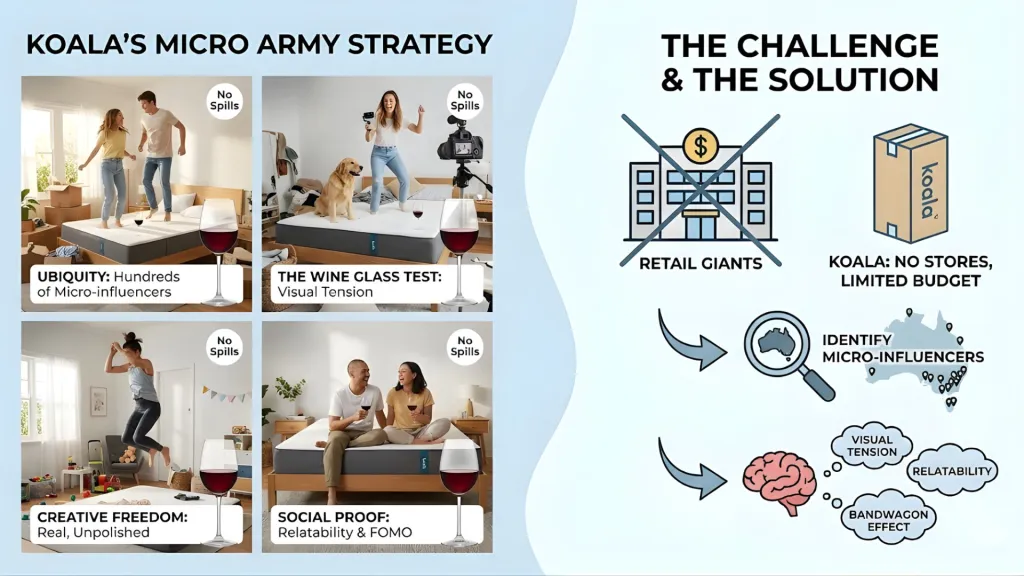
Primary Case Study: Koala’s “Micro Army” Strategy
The Challenge
When Koala launched, they were up against retail giants like Harvey Norman and Forty Winks- brands with massive TV budgets and legacy reputations. Koala had a great product, but they had zero physical stores and limited ad spend. They needed to make people comfortable buying a mattress without trying it first.
The Strategy: Social Proof at Scale
Instead of blowing their entire budget on one A-list celebrity endorsement, Koala opted for a “Micro Army” approach.
- Ubiquity: They identified hundreds of Micro-influencers across Australia- people moving houses, young couples, pet owners, and lifestyle bloggers.
- The “Wine Glass Test”: They gave these influencers a simple, visual challenge: Jump on the mattress with a full glass of red wine sitting on the other side.
- Creative Freedom: They allowed influencers to film this in their own messy bedrooms, with their dogs, kids, and partners. It wasn’t polished; it was real.
Why It Worked (Psychological Breakdown)
- Visual Tension: The wine glass test created immediate visual suspense. Will it spill? This stops the scroll.
- Relatability: Seeing a mattress in a “real” Australian bedroom (not a studio set) made it easier for customers to imagine it in their own homes.
- Bandwagon Effect: Because hundreds of influencers posted around the same time, it created a sense of FOMO (Fear Of Missing Out). “Everyone is getting a Koala mattress, maybe I should too.”
The Result
- Trust: Because hundreds of “normal” people were vouching for it, the claim that the mattress was comfortable became a verified fact in the public consciousness.
- Content Library: Koala gained access to thousands of pieces of User Generated Content (UGC) that they could repost, saving them thousands in production costs.
- Outcome: Koala became Australia’s highest-rated mattress brand and expanded internationally, largely fueled by this grassroots momentum.
4. The Case for Fame: When to Use Macro-Influencers
Does this mean Macro-influencers are dead? Absolutely not. They play a different, yet vital role in the marketing ecosystem. While Micro-influencers drive conversion and trust, Macro-influencers drive reach and status.
The “Halo Effect”
When a Macro-influencer or celebrity aligns with your brand, they transfer a degree of prestige. If a top Australian fashion model wears your local label, it instantly signals to the market: “This brand has arrived.”
When to Choose Macro:
- National Launches: When you need to let the entire country know a new product exists within 24 hours. A Micro strategy takes time to build; a Macro strategy is an explosion.
- Luxury Positioning: High-end brands (watches, luxury cars, designer fashion) need the aspirational quality that only a polished Macro-influencer can provide. A grainy iPhone video from a Micro-influencer might devalue a $10,000 watch.
- Cross-Channel Reach: Macro-influencers often have presences across TV, Radio, and Podcasts, allowing for integrated campaigns.
5. Strategic Analysis: Budget Allocation & ROI
For the average Australian Marketing Manager, the decision comes down to the spreadsheet. Let’s break down a hypothetical $10,000 Campaign Budget.
Scenario A: The “Big Bang” (1 Macro Influencer)
- Strategy: Hiring one reality TV star.
- Cost: $10,000 for 1 Post + 3 Stories.
- Reach: 400,000 followers.
- Risk: High. If the algorithm buries that one post, or if the creative doesn’t land, your entire budget is gone.
- Asset Lifespan: 24-48 hours.
Scenario B: The “Swarm” (20 Micro Influencers)
- Strategy: Hiring 20 niche experts (Foodies, Mums, Tech reviewers).
- Cost: $500 per influencer x 20 influencers = $10,000 (often includes product cost).
- Reach: 20 x 40,000 followers = 800,000 cumulative followers (potential overlap, but higher frequency).
- Risk: Low. If 5 influencers underperform, you still have 15 others generating traffic.
- Asset Lifespan: You now own 20 different images/videos to use in your own ads for months.
Scenario C: The “Hybrid” (The Smartest Play)
- Strategy: 1 Mid-Tier Macro (for credibility) + 10 Micro (for buzz).
- Allocation: $4,000 for the Macro star + $6,000 for the Micro army.
- Why it wins: The Macro influencer provides the “Hero Content” that you pin to your profile. The Micro influencers create the “Echo Chamber” effect, making consumers feel like they are seeing the brand everywhere.
The Verdict: For ROI focused on sales, traffic, and content creation, Scenario B (Micro) wins almost every time for SMEs. However, as you scale, moving to Scenario C (Hybrid) is the natural evolution.
6. Technical Execution: How to Build Your Campaign
Moving from strategy to execution requires a tactical approach. Here is a step-by-step roadmap for Australian brands.
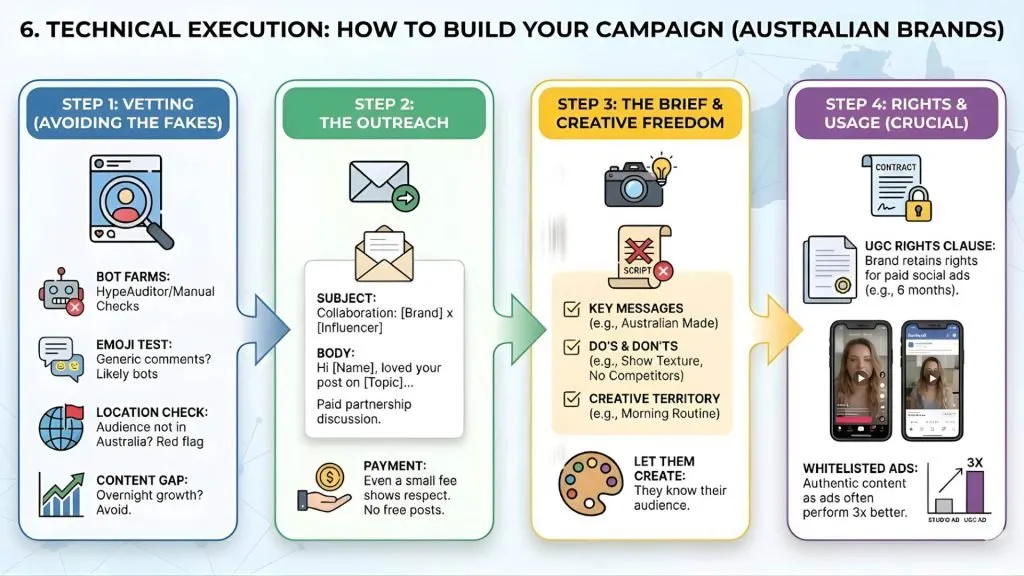
How to Build Your Campaign
Step 1: Vetting (Avoiding the Fakes)
Australia is not immune to “bot farms.” Before booking a Micro-influencer, use tools (like HypeAuditor) or manual checks to audit them.
- The Emoji Test: Look for comments. If they are all generic emojis ("", ""), these are likely bots or engagement pods.
- The Location Check: Check the followers’ locations. If a “Sydney Influencer” has 40% of their audience in Brazil or Turkey, that’s a red flag.
- The Content Gap: Do they post inconsistent quality? Did they jump from 10k to 50k followers overnight? Avoid.
Step 2: The Outreach
Keep it professional but personal. Australian creators appreciate directness.
- Subject: Collaboration: [Brand Name] x [Influencer Name]
- Body: “Hi [Name], loved your recent post about [Topic]. We are a Sydney-based brand launching [Product] and think your audience would love it. We’d love to send you a sample and discuss a paid partnership.”
- Tip: Do not ask for “free posts” in exchange for “exposure.” That era is over. Even a small fee shows respect.
Step 3: The Brief & Creative Freedom
Do not send a script. Australian audiences hate scripted content. It feels fake.
- Instead, provide:
- Key Messages: (e.g., “Must mention it’s Australian made”).
- Do’s and Don’ts: (e.g., “Do show the texture,” “Don’t mention competitors”).
- Creative Territory: (e.g., “Show us how you use this in your morning routine”).
- Then, let them create. They know their audience better than you do.
Step 4: Rights & Usage (Crucial)
Always negotiate UGC Rights (User Generated Content Rights). This is often where the real value lies.
- The Clause: “Brand retains the right to use the content for paid social ads for 6 months.”
- The Benefit: You can take their authentic video and run it as a TikTok Ad or Facebook Ad. These “Whitelisted Ads” often perform 3x better than studio-produced ads because they look organic.
7. Legal & Ethics: Playing by Australian Rules
Operating in Australia means adhering to the AANA (Australian Association of National Advertisers) Code of Ethics and ACCC guidelines.
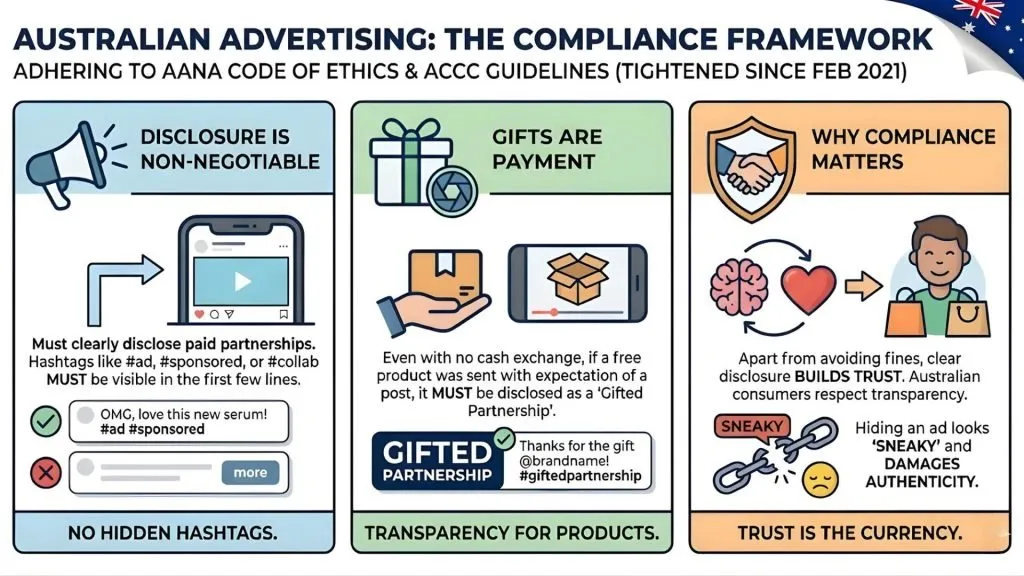
Legal & Ethics: Playing by Australian Rules
Since February 2021, the rules have tightened significantly.
- Disclosure is Non-Negotiable: Influencers must clearly disclose paid partnerships. Hashtags like #ad, #sponsored, or #collab must be visible in the first few lines of the caption (not hidden in the “more” section).
- Gifts are Payment: Even if no cash changed hands, if you sent a free product with the expectation of a post, it must be disclosed as a “Gifted Partnership.”
- Why Compliance Matters: Apart from avoiding fines, clear disclosure actually builds trust. Australian consumers respect brands that are transparent about their advertising. Trying to hide an ad looks “sneaky” and damages the authenticity you are trying to buy.
8. Platform Specifics: Where to Play?
- Instagram (Reels & Stories): Still the king for lifestyle, fashion, food, and interiors. The “Aesthetic” matters here. Stories are powerful for driving direct link clicks.
- TikTok: The home of “unfiltered” reviews. Ideally suited for Micro-influencers. The content here should be raw, funny, and educational. Perfect for beauty, tech, and FMCG.
- LinkedIn: The sleeping giant for B2B. If you are selling software or services, “Micro-influencers” here are industry thought leaders. A post from a respected consultant can drive massive B2B leads.
9. Actionable Tips for 2026
- Prioritize Video: Static images are fading. Short-form video (Reels/TikTok) is the dominant currency in Australia right now.
- Localize Your Strategy: Don’t just target “Australia.” Target “mums in Brisbane” or “creatives in Fitzroy.” Micro-influencers allow this level of granular targeting.
- Long-Term Partnerships: Instead of one-off posts, sign Micro-influencers for 3-6 month ambassadorships. The repetition builds familiarity and trust.
- Embrace “De-influencing”: A new trend where creators tell you what not to buy. Encourage your influencers to compare your product honestly with others- confidence in your product sells.
Conclusion: Authenticity is the Ultimate Currency
The debate between Micro and Macro influencers is not just about numbers; it is about the philosophy of your brand. In a market like Australia, where skepticism is high and community is valued, the “hard sell” is dying.
The future belongs to brands that can weave themselves into the fabric of everyday life. It belongs to those who understand that a recommendation from a trusted peer is worth ten times more than a generic endorsement from a superstar.
Whether you are promoting a new skincare line, a tech gadget, or a travel experience, the goal is to create a genuine connection. This philosophy is universal across industries. For example, at Australia Experiences, our mission has always been to connect travelers with the real soul of Australia, moving beyond the tourist traps to find authentic, local moments. We understand that the most powerful stories often come from the locals who live them every day.
By shifting your budget towards specific, high-engagement Micro-influencers, you aren’t just buying “views”; you are building a community. And in the long run, community is the only competitive advantage that cannot be copied.
FAQ: Frequently Asked Questions
Q1: How Much Should I Pay A Micro-influencer in Australia?
A: Rates vary, but generally:
- Nano (gifted product only or $50-$150).
- Micro ($200 - $800 per post).
- Macro ($2,000 - $10,000+ per post).
- Always negotiate based on deliverables (e.g., +1 Story, +Rights to use content).
Q2: Can I Just Use a Platform to Find Them?
A: Yes, platforms like Tribe, Vamp, or The Right Fit are popular in Australia. However, hand-picking and manually vetting influencers often leads to better, more genuine relationships.
Q3: How Do I Measure ROI if They Don’t Generate Immediate Sales?
A: Look at “Cost Per Engagement” (CPE) and “Save Rate.” If people are saving the post, they are considering the purchase later. Also, value the content created- how much would it have cost you to hire a professional photographer to take those shots? Often, the content value alone covers the influencer fee.
Q4: Is It Better to Send Products for Free (Gifting) or Pay Cash?
A: For Nano-influencers, gifting often works. But for quality Micro-influencers (10k+), paying a fee ensures professionalism, adherence to timelines, and guarantees the post actually goes up. “Gifting” often leads to “ghosting.”